Showing posts with label geometry. Show all posts

Sunday, January 26, 2025

Book Review: Solving Stonehenge

Closeup of three openings in the sarsen circle at Stonehenge.
I’ve just finished reading Anthony Johnson’s “Solving Stonehenge: The New Key to an Ancient Enigma,” first published in 2008. The basic gist of the book is that the primary astronomical alignment of Stonehenge is a reflective axis along the winter solstice sunset / summer solstice sunrise; the placement of the fifty six Aubrey holes, the thirty stones for the sarsen circle, and the upright stones for the five trilithons can be described—not by alignment with whatever star is handy—but by using a regular octogram of two squares to fix the position of key points and deriving additional stone points from arcs built from the octogram’s vertices. No need to conjecture Megalithic Yards for the accuracy of alignments; it’s all done with circles, squares, and simple peg-and-rope geometry.

Although he does throw some shade on “Stonehenge Decoded,” Johnson’s crankiness about astroarchaeology (and computers) comes through as an exasperation that never quite reaches entertaining levels of snark.

Interior view of the curve of the sarsen circle at Stonehenge.
The first several chapters are a historical review of various scholars, antiquarians, myths, speculations, and archeological theories around Stonehenge, with a focus on survey work. There’s a brief pause to question the racial distinctiveness of the “so-called Beaker People,” and a later a detour to discuss the geometric design elements of the Bush Barrow lozenge (~1750 BCE). Arguments, more like geometry demonstrations, for the underpinnings of the monument aren’t given until chapter 8, on page 207, about two-thirds of the way through the book.

Johnson is more interested in how the builders of Stonehenge built the monument, but not on why they did it—which is fair, since Johnson is a surveyor and the ancient builders left no written records telling us why. The conclusions of the book are 1) that the geometric steps that can be used to construct the pattern on the Bush Barrow lozenge are similar to the steps which can be used to construct the placement points for many stones and holes at Stonehenge; 2) searching for astronomical alignments within the monuments is unnecessary and distracting; 3) the stones can move or be moved around a lot in four thousand years; 4) that despite incorporating pagan mumbo-jumbo and Druids into it, John Wood’s 1740 survey of the monument is Very Good; 5) “there is absolutely no way that the master design of the central sarsen structures or even the earlier arrangements can simply have been worked out ‘on the ground’ without first having been drawn on a prepared surface…”.

“Solving Stonehenge,” is dry, but interesting; I’d say Johnson is writing for amateur surveyors and archeologists and Stonehenge historical enthusiasts. It’s a more scholarly book than some of the much briefer (but much more woo-woo) Wooden Books publications on geometry or astronomy that I own. I came (and stayed) for the Stonehenge parts, and the book’s focus is more on the geometry of surveying. I appreciated that Johnson showed his work in the earlier chapters, but I could have been satisfied with a summary of chapters six, seven, and eight. Mark, of course, accuses me of giving resources to the “Stonehenge-Military-Industrial-Complex,” and opined that I should be reading a peer-reviewed journal covering archaeoastronomy instead.

Circular pegboard with two rings of 56 holes and a straight line of 14 holes centered on the board. Shadows cut across the board and the five pegs positioned on the rings and line of holes.
While I was reading “Solving Stonehenge,” someone asked me what it was that I found so compelling about Stonehenge. I had to pause and think about it for a while before I came up with an answer that was satisfying. There is no one answer. Part of it is the mystique surrounding the site (and being able to sing along with Spın̈al Tap about the Druids); who wouldn’t be drawn to the wonder-stories woven into the tapestry of the Matter of Britain—it’s magical. Part of it is that the stones of Stonehenge and the site itself, which I’ve been fortunate enough to visit, are beautiful and impressive; four thousand year old neolithic architecture does have its physical charm. Another part is that the arches imply portals and the romanticism of being transported to an other place or when. Part of it is how the placement of the stones interlocks with the sky’s geometry, which appeals to the part of me that builds sculptures out of forks interlocked by their tines, tracks the motion of the sun and moon on a home-built portable Aubrey hole pegboard, and owns pierced gnomon spherical sundials. But I think the main reason I find it compelling is that Stonehenge is massive statement about human participation with and appreciation of the site’s locality; it’s a place that draws one’s attention to the sun’s (at least) motion and the land’s response, and in doing so becomes an axis mundi.

Sunday, November 20, 2022

Repeating Patterns

Geometric pattern consisting of groups of three pentagons arranged into a hexagonal array.
It's that pause during the year before it seems like everything happens all at once.  Thanksgiving will hit, I'll need to figure out some sort of holiday craft gift, start production, and mail out items soon.  And set up a Winter Solstice Lights Spiral.  While trying to write, going to work, and other everyday tasks.  Somewhere in all of this we want to send out holiday cards, too.  

We've made some fairly creative holiday cards in the past; I think "Smokey Knew He Could Save Christmas" was my favorite.  A few years ago, there was an abortive attempt to have us riding the notes in a music score for "Jingle Bells," but Mark thought it was "too gay," and we've devolved to generic portraits.   Perhaps this year's card will be "Merry and Tired."  


The other day I finished "wiggling tiles," as I liked to put it, and came up with a tile pattern using pentagons.  

Groups of three pentagons arranged into a hexagonal array.
I was pleased with the effect, but I had a suspicion that I'd done something similar.  Sure enough, as I was going through my photo collection to try to find pictures for a family 2023 calendar, I ran across a design I'd done last spring that was virtually identical.

And looking more closely, this is essentially a variation of interlocking circles within a hexagonal array, which I did a variation of last November.  I suppose there's only so many ways one can have repeating infinite tiles using pentagons, and it involves arranging them around hexagons.  


Sawtoothed circles arranged in a hexagonal array so that the teeth form snowflakes, hexagons, and six-pointed stars.
I'm trying to decide if Twitter imploding is a good thing or a bad thing.  

On one hand, I have some contacts with writers, Math Art Folks, archeology, Pagan, and folklore specialists that I would hate to lose; on the other hand, having one less social media site to visit might not be a bad thing—Ursula Le Guin famously did not have a Twitter account.  On the first hand, it's kind of fun to see what other folks are doing, especially when I remember to use curated lists; on the other hand, virtual friends are virtual, and none of my family are on Twitter.  And then there's the whole DoomScrolling thing.

I might post more directly to this blog and less directly to other social media sites in an attempt to simplify my life and also to exercise my ability to focus on something longer than 256 characters, which feels like it has atrophied in the last two and a half years.   We'll see how well that works; Twitter (and Instagram) make it easy to fire off a quick post.  The same quick post with Blogger takes a little more effort (fire up a computer, upload photos, write text, import photos...) mostly because there appears to be no mobile app for Blogger.  

I'm sure there's a metaphor in there, somewhere.


Tuesday, March 15, 2022

Adventures in Math Art

The other day I saw a design out of an old Arabian dictionary.  It was two interlocking squares, joined together by arcs into one continuous line.  It looked like something I could copy with a straight edge and compass, and in fairly quick order, I was able to work out the underlying geometry.

I worked on a color version in InkScape.

The next day, I wondered if one could do something similar with two interlocking pentagons.  Since it's slightly easier to make a pentagon in InkScape than with analog tools, I sat down at the computer and worked out how to place the arcs on the lines.  Since I was working with pentagons, I decided to use red as the main color. 

The next day after that, I wondered what other polygons would work with the interweaving straight lines and arcs arrangement.  I thought hexagons would be too tight for the arcs to fit aesthetically, and two interlocking triangles would result in "Happy Hanukah" jokes from Mark.  So I set out to work with a septagon.  

This is where I discovered that the figures with angles more acute than right angles don't allow arcs to nestle into their corners so easily.  I had to experiment with septagrams with rays of various thicknesses before finding one that would work.

The arcs, it turns out, will have an angle of 180 minus (360/number of corners in the figure) and be centered on the intersection where two lines meet.   I think the double-square pattern came out the best; the other two are fine... and I have a feeling I could nudge the radius of the arcs and the thickness of the lines some to make the "spokes" of the pattern more even.

I like them, and maybe I'll put them into a story. . . 

Friday, November 27, 2020

Squares, Stars, and Icosagons

On the creative front, I've come up with some holiday patterns in InkScape to use as backgrounds for when I'm telecommuting to work or holiday events.  I started with a square, then I duplicated them so I had five, then rotated them 72 degrees and grouped them into star patterns.  The star groups are either pointed upward or downward.  

Pentagonal designs tend to fall into two categories:  five or ten rays radiating from a central point, or rings of alternating units.  


The first design I came up with starts with a upward pointing star group; each of its five edges are joined with the edges of a downward pointing star group, which forms a ring around the center; each of the ten free edges on the downward pointing star groups are joined with an upward star, forming another ring, and the whole design keeps repeating that way.  What's interesting to me is way almond-shaped gaps open up in the network of star groups.


For the second design I wanted more complete circles (actually bevelled decagons or icosagons).  The decagons can only hold three star groups at most, with the result that a decagon can only overlap with at most only two other decagons.   In addition to the almond-shaped gaps, packing the decagons together creates a boat- or T-shaped gap and also a star-shaped gap in the arrangement of star groups--I arranged star groups in a way that would favor the creation of complete decagons and star gaps. 

The third design is the second one, only zoomed out a little.  Since this is all done with pentagonal symmetry, the designs end up looking like zilij or Penrose tilings.  I suppose I should go back into InkScape and change the colors; red and green are traditional for the winter holidays, but a number of people have commented that the contrasting hues make them dizzy.

Monday, January 20, 2020

More Wiggling Polygons

Lately, I've been wiggling shapes together to try to make interesting tessellations.


I have to say every time I make a foray into this sort of design, I have to stop an appreciate 500 year old tile artists who managed to work out these patterns without computer assisted drawing (although, they do fudge shapes away from strict geometric polygons).


What typically happens is that I start in on a design that clicks into place on a local level but once I start to extend the repeats out -- or try rotating the whole pattern 120 degrees instead of 90 -- there's a fractional repeat that starts adding additional recursive shapes.


Theoretically, one could get around the difficulties of using both squares and triangles by designing a pattern with twelve-fold symmetry).


Looking at books on design, it seems the best strategy is to arrange squares and triangles and stars along radial guidelines and then wait for patterns to snap (mostly) into place.


Five-fold symmetry, as I've noted before, is very hard to tessalate unless one folds the two-dimensions of the workspace into three dimensions.  My intuition tells me that folding a pattern of ten stars into a regularly repeating pattern is somehow part of the same property of our universe that means you have to fold sound somehow if you want to make seven octaves and twelve fifths a unison.


Sunday, August 13, 2017

Sand Castle

Thursday, Aug 3

Today was a sandcastle day!  I went out to the beach around 9:30 with my compass, yardstick, and small bag of supplies.  Low tide wouldn't be for a couple of hours, and nary an umbrella could be seen on the wide, flat shore stretching away north and south.  The day stretched forward like the smooth sands around me.

First I made a net of circles--a tessellation of six circles around a seventh in the center.   It's a relaxing pattern that let me get a feel for how the compass would respond in the sand.  I continued the net out and then highlighted various circle sections to add some visual variety.

Then I made a simple spiral labyrinth; next a bird constructed of repeated circles on a line.  The bird came out vaguely flamingo-like, so I added a small hedgehog next to it.  By this time I noticed that I needed to hold the apex of the compass in my palm if I wanted to avoid having the rubber bands in the hinge flex and make different shaped circles.

The occasional jogger and one beach comber with a metal detector came by.  A woman asked me if it would be OK for her to photograph my labyrinth.  Later, a woman and her child stopped by; we tried to interest the child in walking the labyrinth, but she only wanted to watch adults walk the spirals.

A group of four teen boys set up the first umbrella; they had some musical device with them which was slightly annoying, but easy to ignore.   Mostly they sat in beach chairs looking out over the waves.

It was time to design the sand castle.  I wanted it to be more historical than random.  I drew a very large circle, then two interlocking squares for placement of eight outer curtain wall towers.  Then a smaller circle and square arrangement within for the inner curtain and central keep.  I suppose that historically, this would make my castle a late fourteenth century castle, with towers in corners supporting outlying towers from cannon fire.

A retired engineer came up to see what I was doing, and we had a talk about castles and Oregon -- it turned out he had done some consulting on structures' abilities to withstand waves at various points along the Oregon coast and sort of knew Corvallis (where OSU has a wave lab).

I returned to construction.  One of the supplies was a simple tower sand-mold, so I placed some of the towers.  The resulting towers were simple, but towering enough.  Sand from the excavated moat was piled into the center for the keep.  Occasionally I would pour water onto the pile and pound it to consolidate the sand into a mass I would be able to carve.  In the back of my head, I recalled that sand sculptors said they started at the top of the sculpture and worked their way down.  The tower-mold helped a lot, and by happy coincidence, seven in a row was the length of the inner curtain square.

At some point, my legs were cramping from all of the crouching, digging, and inscribing in the sand.  The beach started to fill up.  I wondered where the Dwyers were.  More people joined the four teens, and I saw that they were Canadians.  Sure enough, Marc appeared, said hello, and then a bunch of them walked toward the ocean with snorkels.

Later, the Canadians, spurred on by Marc, broke out shovels and pails and in no time had two large mounds built.  A few towers dotted the mounds, built from the deep trenches.  Another family on the other side of me also had shovels, which they used to make a kind of sea wall between the now incoming tide and their encampment of beach umbrellas, towels, and chairs.

On the other side of the seawall folks, I saw the Dwyer camp.  I saw Mark and The Child and walked over to him and sang a re-worked song from Avenue Q, "Oh, I wish you could meet my boyfriend / but you can't, 'cause he lives in Canada!"

"Oh," said Mark when he saw Marc.  "I spoke with him the other day; he's just friendly -- I don't know what my family is talking about."  Mark then went on to point out to me that my back was beginning to sunburn.  Twice.

I gave Mark and The Child a tour of the sand-works so far. The Child seemed nonplussed, and was more interested in swimming.  They added a few towers to the outer curtain and then left.

Finally, the castle was finished, or at least as finished as I wanted it to be.  I worked on another design, which started out like a racetrack and then started to look vaguely sexual, so I added more half-arcs to make it less like a yoni-lingam and more like interlocked arcs, which then threatened to turn into a swastika, so I stopped and took all my tools to the Dwyer encampment.

The tide would be splashing over the sand soon, and I was tired from all of the construction.   I'd noticed a small boy running back and forth and he finally built up enough courage to ask me if I had done all the drawings, and how (at first I thought he was one of those monsters who stomps on unattended castles).

"Hold, on," I said.  "Wait right there; I'll be right back."

He rooted himself to the spot, and I returned with the compass and ruler.  I explained how the compass opened and closed and let him have a go at it.

"Hold it and walk backward," I said when he jammed the compass into the sand and couldn't move it farther.  He made a circle and handed the compass back.

A woman, presumably his mother, hovered on the edge of our conversation, nodded her head and made a calculated grimace which I interpreted to mean "OK, this middle-aged, bearded Oregonian appears to be not summoning demons" and then wandered away when all we were talking about was geometry.

"Circles like to make triangles and hexagons," I said.  "What's your favorite shape?"

This seemed to confuse him and he said he pretty much liked all shapes, but that squares were cool.  So I used the compass and ruler to make a square in a circle, then extended the diagonals to draw a second square around the circle, and went on to reconstruct the plan of the castle.

He watched, enraptured.  I was glad to show it to him, and wished that The Child shared the interest - but he doesn't, and I suppose he makes up for it by enjoying Monty Python with me.

Later on, the tide came in.  At first the lapping waves cascaded into the moat, and I thought the castle would stand for a while.  But, I'd left an opening in the walls for the gate and the water poured through it much more vigorously than I'd imagined, and the castle fell to the waves within minutes.


That evening, with some amusement, we realized the Canadians were renting a house directly across the street from ours.  This of course prompted more renditions of "I wish you could meet my boyfriend."

Dinner was casual.  Afterward the kids went to the boardwalk, and The Child had fun smacking into mirrors in a mirror maze.


Saturday, August 12, 2017

Figures in the Sand

Wednesday, Aug 2

I dreamed that I was supposed to fill in for one of The Child's teachers, but somehow I had a dental appointment instead.  When I got to the class, the teacher's assistant, who was very miffed, said she'd gotten the class organized and now it was my turn to take over.

Things got jumbled.  The 2017 eclipse was happening, but it was cloudy.  Insert a cool computer graphic of the cone of the umbra touching down on the globe here.  Between thick clouds and a streetlight, we did manage to see the sun's corona, and then The Child was missing.
More jumbled scenes with tunnels and Batman being killed by the Joker.


Apparently, while Mark and I were enjoying a lovely evening reenacting "Moulin Rouge" from the back of an elephant's hadow, our niece, Shannon, and a cast of aggressive terns were reenacting "The Birds" on the Ocean City boardwalk (they wanted her fries).

Mark and I went to the hardware store and he purchased a measuring cup so he could make pancakes and I purchased a yard stick to help with sand drawings.

Before high tide, I was able to make a decagram, but I couldn't remember how to get the stars around the ends so they circled up.  I think next time I'm going to have to draw to interlocked pentagons and go from there.  I did manage to diagram a hexagon and conjoined pentagon.

The compass mostly works, but I have to pay attention to how I'm holding it so it doesn't flex out of the circumference I'm wanting.  The yard-stick works mostly for making lines, but it works better as a guide for the last remaining shish-kabob stick.

When I was finished with various circle and line constructions, a Montrealer (named Marc) came up and asked about what I was doing.  I was a little worried that he might launch into a "are you summoning demons" tirade, but I explained that some people knit to relax and I like making geometric constructions, and added how I was getting messed up trying to find the golden mean for some of them.  He seemed very interested in various drawings in my Book of Art and we chatted for a few moments.  It was a refreshing change from the "OMG, a Satanist!" looks I usually get on the Oregon Beaches.

Shortly afterward, the tide came in and wiped out all the circles and lines.  I'm sure there's a metaphor in there, somewhere.


After dinner, several in-laws informed me that Marc from Montreal had been hitting on me.  "He was standing really close to you," one said.  "I almost went and got Mark."   At the time over various geometric figures in the sand, I thought he was simply curious about what I was doing--but I had wondered as I trudged back from the beach if perhaps I had been so focused on the Golden Mean that I missed an undercurrent in his body language... and then dismissed the idea because he seemed about twenty years my junior.

In the evening, the family split up.  Some folks returned to Atantic City, others went out for a fish dinner, some to miniature golf, and others stayed home.

I stayed home; I tried to set up a table on an outside porch, but it was less rain-proof than I expected -- which was too bad, because I'd set up a table and chair to escape the episode of "Law and Order" that was on the TV.  I ended up writing to some baroque music I had on hand for just such a situation.

Sunday, June 19, 2016

Paper Star Laser Project

 For Father's Day I made a star ball out of paper.  This one would be based on a zillij pattern of a decagram surrounded by ten stars, and would make a dodecagon.  I've liked this pattern, and I've always wanted to make a repeating design that was interlocking circles of stars, but the pentagonal symmetry of the pattern means that some of the stars get deformed in order to make the design fit (here's an example and here's another).  After staring at the design I figured I could make something out of six copies of two conjoined decagons.

I've been fiddling with stars and decaogns forever in Inkscape, so it was fairly simple to make a design, export it to DFX, and bring it and a stack of construction paper to the Eugene Maker Space to laser.

I could have made a design that fit on a 12 inch by 16 inch piece of paper, but I'm glad that I stuck with regular-sized paper because the end design would have been inconveniently large.  I closed down CADQ and restarted it fresh, and the system worked without problems.  I told the laser software that I was using construction paper, set a thickness of 0.005 inches... and four minutes later pulled out a laser-etched design on a sheet of paper.  There was a smell of scorched wood fibers, but the design had not been cut out.

At this point, I realized that I'd forgotten to bring the laser cutter's bed up to the focal length of the laser.  I raised the bed  to its full height and discovered that this was a little short of the recommended focal length suggested by the manual tool.  If I'd been a purist, I would have found a half-inch tray of wood for the paper to sit on.  I nudged up the thickness to 0.030 inches.  Four minutes later, I had a design that was mostly cut out, except there were a few places where the fibers hadn't been severed all the way.  I recalled something about green materials interacting with the laser and wondered if this particular shade of paper was reflecting the laser.

But it worked.  I was ready to try halving my cutting time by cutting two -- two! -- sheets of paper at a time.  Cutting multiple pages at a time would be much more quick than using a razor bladed Silhouette cutter-plotter.  I nudged the laser's thickness cutting power to 0.060.  The laser control flashed a warning: something about the power setting exceeding the recommended levels for paper.  With the hubris of Victor von Frankenstein, I proceeded.  About two minutes later the paper caught fire.  I hastily halted the laser, snatched the still-burning paper out of the laser cutter's bed, and stomped the flames out while singing, "Crap crap crap crap!"  Gentle reader, I beg you not to tread the paths of hauteur:  heed the warnings of the machines, lest you feel the chastising heat of flame and ashes are the fruit of your artistic craft.

Taking the more cautious path, I resolved to set the thickness to 0.040 inches and double-cut single sheets of paper.  I believe this is still speedier than the aforementioned Silhouette  cutter-plotter, and it does have the advantage of not having to peel the finished design off of an adhesive cutting mat.  Another advantage is that the laser cannot snag on the occasional thicker paper fiber, resulting in a torn product.  The disadvantage, is that, once again, the laser reminds me that it's actually vaporizing/burning away the materials it cuts, and each page has a faint campfire aroma.

I has the laser cutter produce seven copies of the design.  I only needed six, but I figured having a spare would be a good thing in case I made some horrible error in construction.  In any case, it was also the end of a long day, and I figured I should finish the construction when I was rested and less liable to make some sort of goofy mistake.

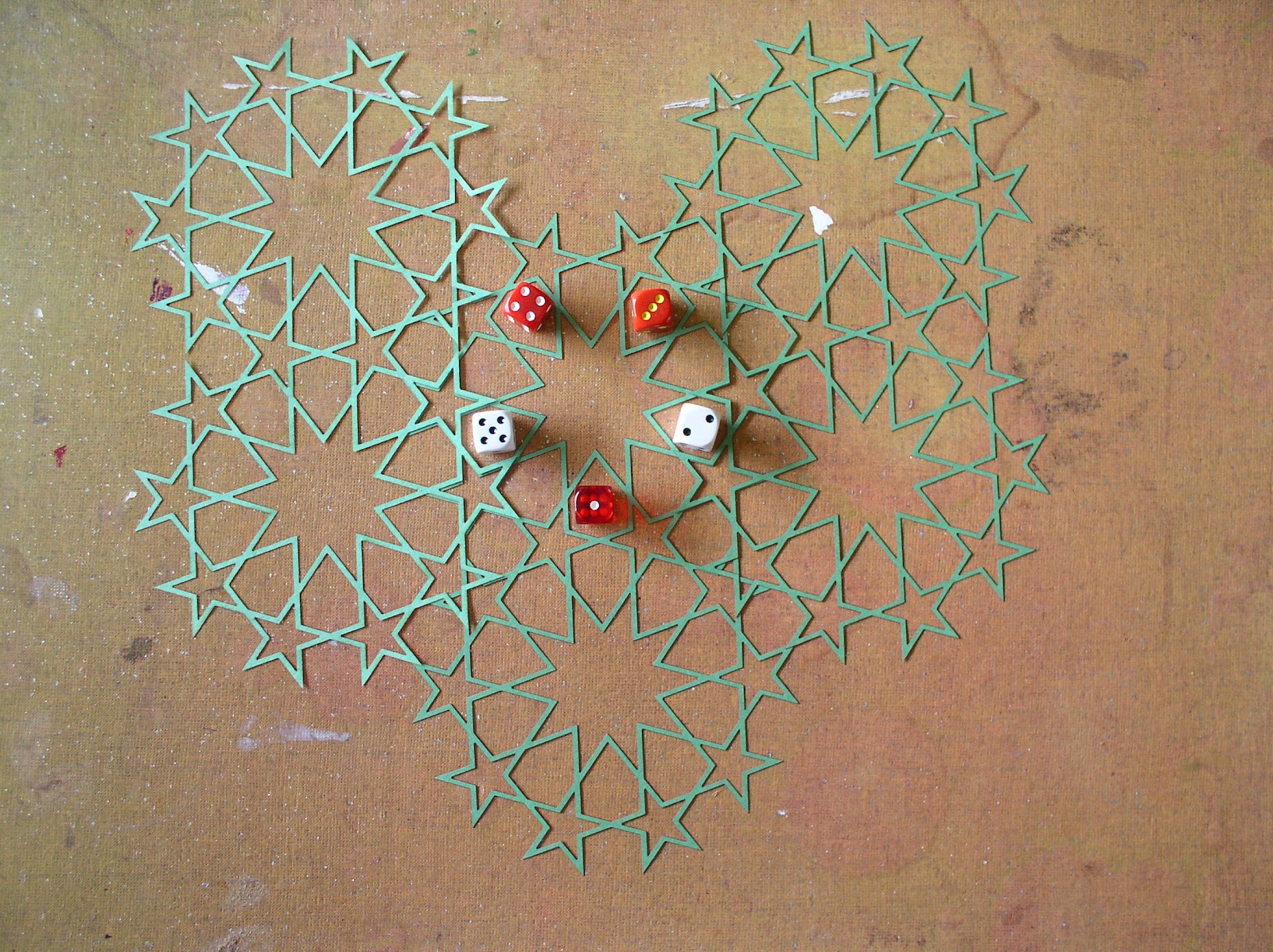
The next day, I set out the design.  I had been mulling over exactly how I was going to glue the designs together so I wouldn't have a gap or too much overlap in the finished dodecahedron.  I put three of the designs together and mentally rolled the various stars around to make sure they aligned correctly.  Popping out of two dimensions into a third is tricky for me, and I had to rely on my previous work and trust that everything would fold together.

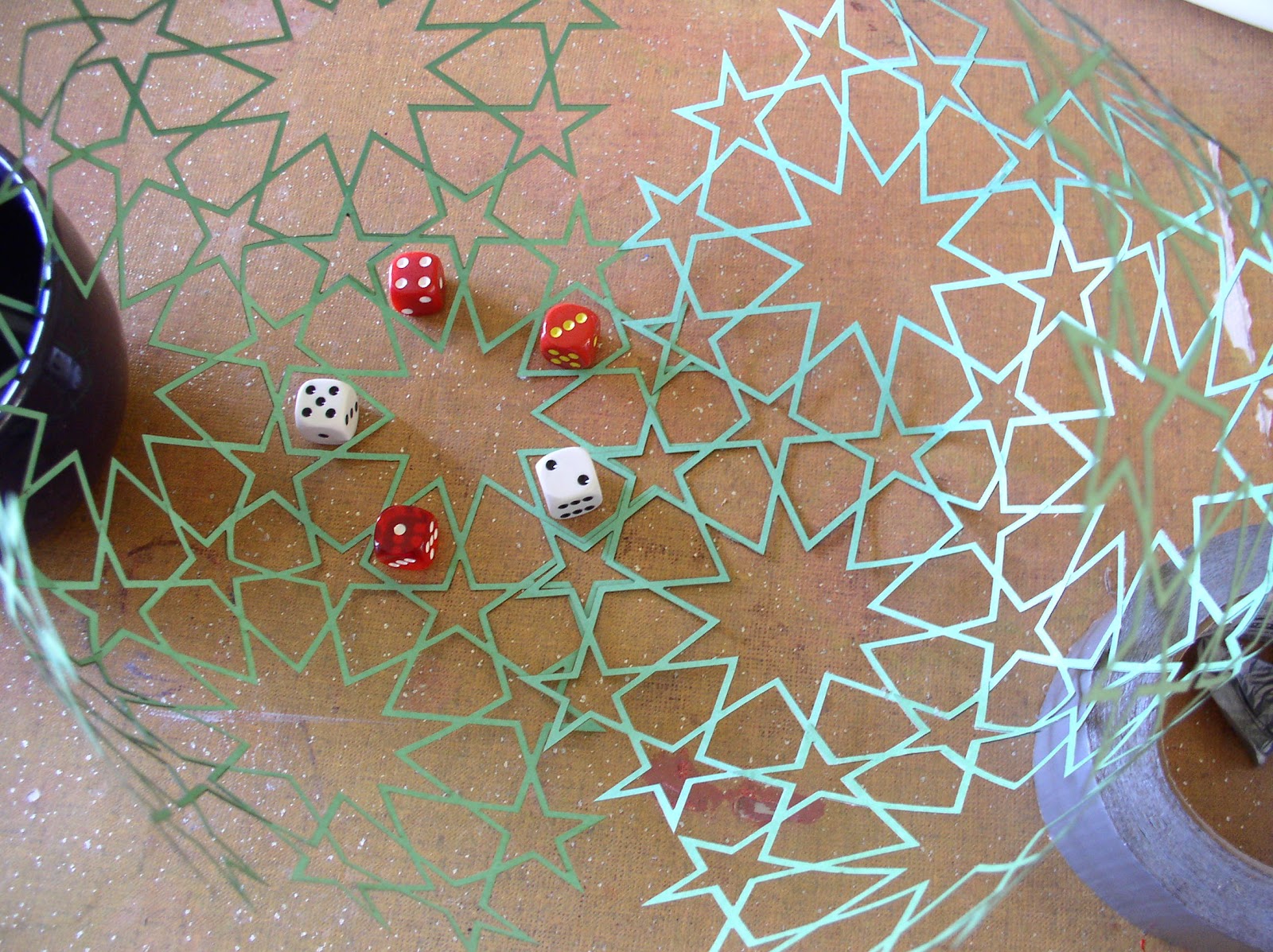
Since I'm pasting and bending twelve decagram together into a dodecahedron, the thing to keep straight was that every other "ray" from a decagram would be shared with an adjacent decagram, and that that ray would be perpendicular to the edge of the finished dodecahedron.  The alternate rays would lead to a triangle of three stars, and would be analogous to a dodecahedron's vertex.  I photographed the design with some dice to make things clearer to myself and to document the process for five years from now when I'm trying to remember how the heck I put everything together.


After that, it was a process of pasting overlapping stars.


And pasting....


And pasting...


And taking time out for artistic shots of nets of stars..


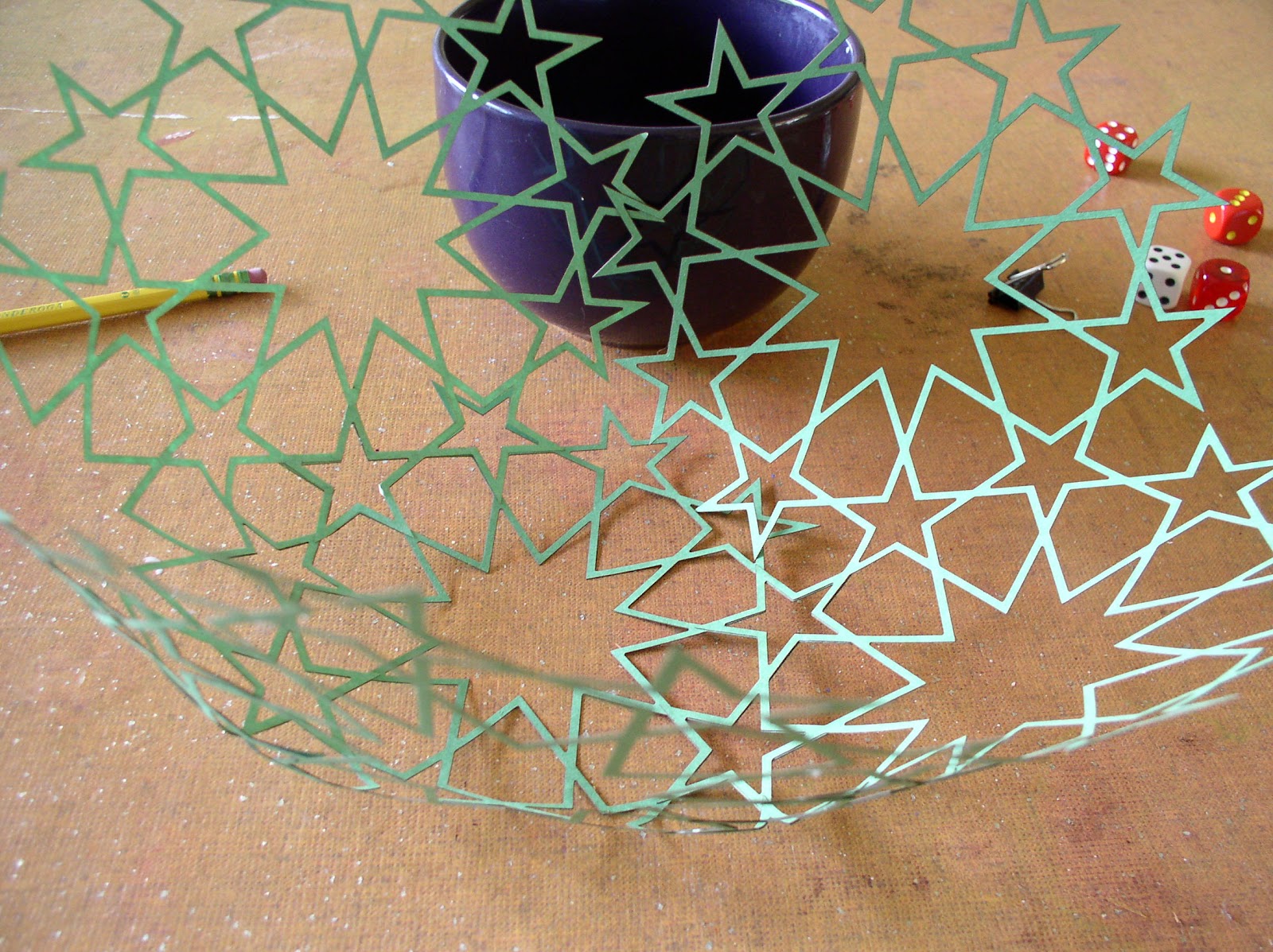
 The decagram in the middle of the ring of stars made the design more flexible that previous, more compact and hexagonal designs.  The result was a floppier mesh.  I used a giant mug to prop up the semi-completed half of the dodecahedron while I worked to join stars together.


After the first four or five stars had been joined together, it became much easier to see how and where to join the next set.  I used the eraser end of a pencil to hold the stars together; I also used my fingers, but the Elmer's glue was more likely to adhere to my fingers, and the eraser against the table method resulted in flatter, less wrinkled joins.


This picture -- actually, the one above, too -- shows how a triad of stars comes together (look at the base of the tea mug, a little to the left).


More artistic photographs.  Sometimes I think it could be interesting to make this out of some kind of shiny metal.


A completed bowl of six pentagonal faces joined together.  Someone at the Maker Space had wondered how rigid the structure would be; once all the stars are glued together, the structure is fairly rigid.


Two bowls side by side.


Now I have to make sure that I'm putting them together correctly.


The dice make a reappearance to show which rays lead to decagrams and which lead to star triads.


Another documentation photo.


Working the two rims of the stars together.


 Art shot.


 Combining flat stars groups of stars together into an undistorted three dimensional pattern is very satisfying to me.


Finished dodecahedron from above, with the spare mesh to one side.


 I'm pretty sure I have to go read some William Blake poetry now.