Showing posts with label astronomy. Show all posts

Sunday, January 19, 2025

No Comets Here

Coastal Mountains and haze on the western horizon after sunset.
The week-long spell of fog broke this Saturday and there was a possibility that Comet ALTLAS G3 would be visible in the Northern Hemisphere, at least according to the photos shared on the EarthSky website. A secondary web ephemeris painted a less rosy picture, and an app on my phone split the difference.  ALTAS G3 was there, and maybe, just maybe, it would be visible from Eugene.

Thinking that I would kick myself if I missed a chance to get a viewing—and photograph—of the comet, I bundled up against the 38F temperature, loaded up my camera and tripod into the car and sped off to Spencer Butte. I was pretty sure that if I tried to see the comet from the top of our local hill, the comet would be behind the South Hills of Eugene.  Or someone's house.  Or a streetlamp.

Snow covered Three Sisters Mountains in the Cascade Range in the evening twilight.
Spencer Butte isn’t that far away, but it’s about a 25 minute mile hike to the 2054 foot summit. Eugene spills out to the northeast, there’s a good view of the Cascade Mountains to the east, and the Coastal Mountains to the west. When I got to the butte's parking lot around 4:30,  it was packed. I rested the tripod and camera against my shoulder and began the assent. It’s been a few months since I last climbed the butte, my not-quite-huffing-and-puffing was a reminder of how I’ve gotten out of shape.

Looking up underneath a pine with frosted white branches painted gold by a sunset.
The setting sun painted the west sides of the pines and shrubs ruddy gold.  A little over halfway up, there was something like white ash on the trail, and occasionally, white flakes of not-snow fell.  I reached over and touched a frosty white branch of underbrush.  The water drop hanging from it was rigid ice.  Closer to the summit, the sun turned the frost golden. I paused for just a moment to take a photo with my phone, then I continued on to the final steps along hewn stone stairs.

The sun had just gone below the horizon around 5:00 when I unfolded my tripod just below the old observation point at the butte’s peak. A wind from the north whipped loose strands of my hair. Haze from the week’s inversion smudged the edge of the sky, and low clouds on the horizon glowed pink and crimson. 

The sky was way too bright for any comet to show up.

I was under the impression that the parking lot closed at 6:00, which meant that I’d only have about a half hour to get any good photos. I scanned the horizon, thinking that the comet might be at a magnitude to be visible, but all I saw was a really nice twilight glow and one striking cloud formation that looked like a trireme. The comet might have been behind a band of clouds, or it might have been much dimmer than I thought.

Venus became apparent, so I snapped a photo of it. The layer of haze from the inversion also became apparent.

A young woman—I wasn’t sure if she was in high school or college—asked me, “Is that a camera?” I was a little puzzled by the question—maybe she thought my camera was a telescope, or maybe she meant to ask “What are you doing?”—but I explained that it was a camera, that I was hoping to spot ATLAS G3 (here I whipped out the astronomy app), but that so far all I was seeing was Venus, and that as the comet moved away from the sun, it might be in a better position for viewing, but that it might get too dim.” This seemed to make an impression on her and her female friend, and they left with a benediction of good wishes.

More and more folks left the summit.

Clouds at sunset which suggest a trireme.
I pulled out my iPhone, which sometimes can capture traces of auroras and comets that I’m missing, and snapped a series of photos along the horizon. At 5:30, I checked the astronomy app: it showed ATLAS G3 setting. I took some more photos of the area of the sky where I guessed the comet might be, thinking that seeing the comet would have been much easier from Australia or Ecuador or some other place other than Eugene. 

Then it was time to head back.

The darkness grew. I had rushed out of the house without a proper flashlight. This wasn’t so bad; I could have used my phone’s light, and in any case, I like to walk at nigh without a light. The stone stairs weren’t too much of a problem, but I was glad that it wasn’t too dark when I descended. Two (different) women about thirty feet ahead of me walked with a cell phone light, so it was easy to see where the dark path was going.

Venus (center) in a dark sky.
As I followed, I thought to try to really listen to the woods as I walked (and not think about cougars). I caught glimpses of Venus through the shadows of the tree trunks. Eugene traffic noises floated up from the city. I became aware of brain chatter, and a soundtrack in my head. When I tried not to name the trees or Venus, I heard Ursula Le Guin reading a passage from “She Unnames Them.” I never really got rid of the soundtrack. I did change the brain chatter to “crunch, crunch, crunch” to match my footsteps on the gravel path, but it was still getting in the way of a zen moment in the woods.

The most challenging part of the hike was returning to the parking lot, which was illuminated by a Very Bright Light that blinded me and made staying on the pathway difficult.

And the mounting socket on the bottom of my camera fatigued off when I set the camera against the car's seat.  This will make using the tripod to take pictures of stellar objects difficult.

At home, looking at the photos on a larger screen, I might have gotten a picture of the comet, but its much more likely a bright cloud lit up by the setting sun.  

Wednesday, October 30, 2024

Volcanoes, Petroglyphs, and Sea Turtles

Sunday, October 13, 2024. Volcano Village, HI

Man with a mock-startled expression holding up a tarot card, the Three of Swords
Oh no! Today’s card is the Three of Swords! I’m interpreting this as Last Day of Vacation Mentation… or possibly having to choose which fun thing to visit first. The strategy that I should adopt for future visits is to have a coin to toss to expedite the decision making process.

Rising steam at sunrise, wooden fence in foreground.
Rising early (again!) made visiting steam vents rewarding, as the dawn air is cool and the vents are more dramatic. 

This morning, we visited vents that go deeper into the Earth and hit pockets of sulphur.  The rising vapors contain sulphur dioxide, which forms bright yellow crystal needles near the vents. I suspected and was rewarded when I looked under the wooden railings of the boardwalk we were on and saw very tiny crystals criss-crossing over the wood grain.  I was lucky enough to get a nice close-up of the vent where larger crystals grew like lichen. 

Yellow sulphur dioxid crystals growing on twigs over a natural vent.
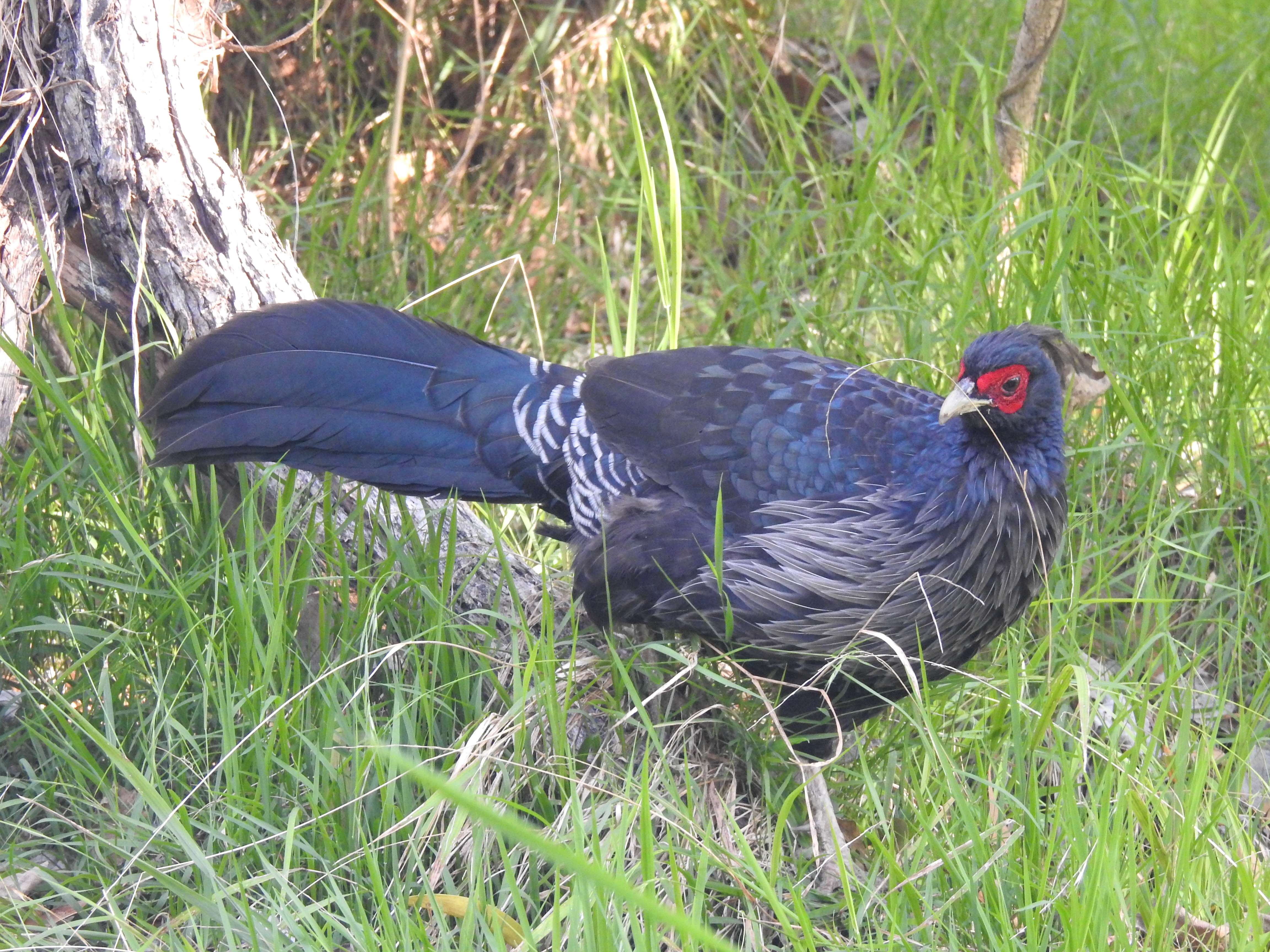
We visited an old-growth forest in Kīlauea park specifically to bird watch, but only sited pheasant/feral ground fowl. I think we had more fun than the bird-watchers from Connecticut, who had come specifically to sight a checklist of birds and had only found one.

A pheasant or feral chicken of some sort.
9:30-ish, we med it back to Volcano House (more parking this time) for the buffet breakfast—shockingly, our meal only cost $50.00 instead of the usual $60.00.

Man in a blue coat looking at tall flowering vegetation from a wooden boardwalk with a rail
We did more caldera site-seeing before returning to the Funky Motel for a nap. Mark saw a Hawiian hawk and other native birds outside on the (dirty) veranda. And also a sign encouraging folks to kill any tree frogs they might see.


Hawaiian petroglyphs
In the afternoon, we drove to the end of Seven Craters Road and visited a petroglyph site at Pu’uloa. The site, a short boardwalk loop, was about a half-mile from the road, at the end of a wind-swept trail over a dusty lava flow. Families would chip a hole in the lava stone hills and place an umbilical cord there for a child’s long life. There were many geometric designs, and a few turtle and anthropomorphic signs as well.

Hawaiian petroglyphs
I had expected the petroglyphs to be on canyon walls, like ones I’d encountered in Arizona, but these were mainly horizontal or on slight rises in the lava flow. I suspect the photography would have been better if we’d arrived closer to sunrise or sunset, but I still managed to get some interesting pictures of the designs.

Hawaiian petroglyphs
We walked along the boardwalk above the markings and tried to fathom what they might mean—did thirteen holes in a row indicate a lunar cycle? What about nine holes around a circle? The strong wind clutched at my hat and blew the seed pods of a yellow, pea-like flower back and forth, which sounded like hundreds of wooden sistrums clack-clack-clacking in a mysterious language. The wind-borne sound ebbed and surged with the gusts and worked its way like a chant into my mind.

Pea-like plant with yellow flower and brownish seed pods.
The mid-afternoon sun was frying Mark, and he endured my photographic questing for as long as he could before announcing that he needed to head back to the car. I admitted that the sounds and the wind were driving me into an overwhelming altered state (i.e. “freaking me out”), and after one more photograph, I followed him back to the car.


Man knitting on a black sand beach.
In the evening, we drove back to the Black Sands Beach for more quality turtle time. When we arrived at the beach, a tour bus was just leaving. The three turtles we’d see basking before were in about the same position in a closed off portion of the beach as they were on Friday.

Sea turtle navigating rocks in a shallow surf.
The basking turtles were high up on the beach—we didn’t see their tracks in the sand and surmised they’d come ashore during high tide. Two more turtles were in the retreating surf and we watched them work themselves over boulders as the sun sank behind Kīlauea. Their shells were shaped like the builders—sometimes they looked like rocks; near sunset they looked like waves. I wondered how heavy the turtles were as they leveraged themselves by their flippers over the jumble of rocks between the shore and the open bay waters.

Sea turtle navigating rocks in a shallow surf.
After the sun set, we left the three formerly-basking turtles on the moonlit shore. Venus came out, but no other stars were visible. We drove back up to the steam vents. 

Nearly full moon above pink clouds lit by the setting sun.
By the time we arrived, it was very dark—I think I saw the end of the comet’s tail over the summit of a volcano, but it looked too big, so maybe it was a sun column. Venus was about ten degrees off of the western horizon with Scorpio chasing after. Not where I was expecting it at all, and tilted ninety degrees sideways, was the Teapot; I realized the zodiac was arcing overhead through the zenith instead of floating over the southern horizon. I’m pretty sure I was saying, “Whoa!” for the rest of the night. 

Mark still thinks it’s pretty funny that I think seeing stars in a different position from a lower latitude on the globe is the coolest, most mind-blowing thing ever.

Wednesday, December 07, 2022

Full Moon Conjunct Mars in Opposition

Full Moon next to Mars in opposition.
Happy Full Moon Before Yule in Conjunction with Opposition Mars.

We thought the sky would be too overcast and cloudy to see anything, but around 8 PM, there was a large enough hole in the clouds to take a few pictures.  

Full moon conjunct Mars in opposition.
Of course I was fiddling around with the tripod and the camera focus to get too many photos before new clouds swarmed overhead, but I did manage to get some shots that weren't too artsy.

The moon was already a little to the east of Mars when we saw it, so I think we missed the actual occultation of Mars.  Still the two were about a fingers-width apart, and while the clouds may have blurred Mars a little, they also cut down on the Moon's glare.


Full moon conjunct Mars in opposition.

Full moon conjunct Mars in opposition.

Full moon conjunct Mars in opposition.


Monday, July 13, 2020

Early Mornings with Comet NEOWISE

 I haven't felt like writing lately, and as a result the blog has gotten quiet.  Some of my writing impulse has gone to Facebook, Twitter, and Instagram -- which is, I suppose, a reflection on my ability to be able to hold more than a handful of thoughts together for any length of time.  I think this is the point where I say something about Mercury going direct and communications opening back up.

On the astro-photography front, I have managed to jury-rig together some zip ties to keep my camera (mostly) on my tripod.  Without the mounting hole in the camera's body, I'm not able to really secure the camera to the tripod, and the zip tie trick is temporary at best.  It worked for some photos that I took of comet NEOWISE over the weekend, but I was anxious that the camera would slip off of the tripod and fall to the ground.

Comet NEOWISE has been visible in the northeastern skies over Eugene, from about 3:40 AM until 4:50 AM, when the Rosy Fingered Dawn makes the sky too light to discern the smudge of the comet and its tails.  Or, at least it has when the sky hasn't been clouded over.  It's below the constellation of a Auriga, which had been off of my radar until last week (although I was vaguely aware of one of its stars, Capella).  Looking at a star chart, I should have at least known that it connects to one of the horns of Taurus.

The cats work me up in time to see NEOWISE  Wednesday, but I wasn't able to pull myself out of bed.  I tried to see it Thursday, but misjudged how light it would be by the time I eventually strolled outside.  The photos I snapped of Venus convinced me that I had to use some sort of stand to hold the camera ready.  Friday it clouded over.  Saturday morning, though, I managed to get out and look for it.  I searched and searched, easily spotted Venus and Aldebaran, but was mystified as to where Capella was, much less NEOWISE.  I figured it was below the tree-line across the street and strode up the hill a bit and managed to sight it.

It's always odd to be photographing the sky in the dark at the side of the street, let alone in an intersection, which was where I was.  I jacked up the camera's ISO up to 1600 to reduce shutter speed.  I hand't figured out the zip tie trick, so I was holding the camera and the tripod mount together with my hand and attempting to zoom and hold things steady as I pressed the shutter button.  And hoping that a car wouldn't come down the street.  After a few shots, I paused to enjoy the comet with my eyes and not through a camera LCD.  Then I went and woke Mark before going back out.

I had taken some more photos from the intersection when Mark came out with Aoife and said that the comet was visible from our backyard (both safer and more shielded from streetlights and porch-lights).   In the backyard, there were more useful references to orient with, including the brick circle.  I took more photos in the brightening sky, then turned the camera to Venus and Aldebaran and the Moon and Mars.

Sunday morning, I got up a little more early, but there was a a skrim of haze over the northeastern sky.  I dozed and intermittently checked the skies until they cleared.  This time, I had the camera's shutter remote (not touching the camera means it's more steady).  I had thought that if I dialed back the ISO to 400, I could have a longer exposure time (3 seconds).  I think a combination of subtle tripod slide, the haze, my inept focusing, and the increased exposure time wound up with, well, I suppose I could say the photos that came out looked like van Gogh's "Starry Night."...

I experimented with turning the ISO up to 3200, thinking that I would be able to increase the shutter speed.  However, there's an interlock that moves the limit on the timer.  What I learned was that while theoretically a half second exposure at 3200 ISO is equivalent to a second exposure at 1600, the shorter exposure picture comes out bluer and whiter than the longer one.  The other lesson is that camera takes sharper images at slightly less full zoom than at full zoom, and that fine-tuning the focus on a star and then not changing the zoom really is a must.

I'm looking forward to later in July when NEOWISE becomes an evening sky object and hangs out underneath the big dipper.  For one thing, I won't feel so indolent for the rest of the day after getting up so early.  I'm also hopeful that as the comet gets nearer to Earth, it will become larger and brighter.  I think the last comet I saw (sort of) was comet Hale-Bopp, back in 1997 (although I remember the local flooding more than the comet).  Looking through historical records, Oregon must have been clouded over in January 2007, because I don't remember seeing that comet, either.

Friday, February 21, 2020

Moon And Jupiter

 Wednesday (2/19)morning, I tried to take some photos of the Moon as it swung by Jupiter.  Luckily, I didn't have to get up at 4:30 to take pictures.

 I think the cold must be affecting the camera, or else I'm doing something fundamentally wrong when I focus the scene:  a majority of the shots came out blurry (I'm wondering if some combination of my progressive lens glasses and my far-sightedness is coming into play).  Another possibility is that the sky has been turbulent, resulting in wavering images.

In any case, many of the photos came out blurry or slightly out of focus.  The best photos are the "arty" ones with utility lines dividing the sky into sections.

Because it's been kind of nippy out, and because the moon is so low in the sky, I've been throwing my old Black And Purple Cloak on and scampering across the street to photograph the moon over our house.   I'm hoping that one neighbor in particular, who can be very timid, did not happen to be awake and looking out of her kitchen window.  I can imagine her calling 911 to report a Satanist (me, in a cloak) performing some kind of lunar ritual (or something) in the street with a strange device (my camera tripod).

This morning (and yesterday when the Moon was right next to Mars) string of the planets and the Moon was stunning.  Thursday morning, when the Moon was next to Saturn, the clouds and fog were out, so the sky was mostly featureless -- although the moon rose so near to sunrise that I'm thinking it would have been very difficult to see even with a clear sky.


Wednesday, July 31, 2019

Moon and Aldebaran


Over the weekend, I took some photographs of the Moon and Aldebaran.  This time around, the Moon was a crescent as she danced through the constellation of Taurus.  I would have liked it if the Moon were visible when it was much closer to Aldebaran, but that would have required taking photos on the other side of Earth. 

More photos of the Moon and Aldebaran may be found here


While I was at it, I snapped a few shots of the Pleiades. 


Friday, July 19, 2019

Writing Day

I'm calling this picture, "Curiosity, before the pavilion of the subconscious, turns away from the font of dreams."

Went to the gym Wednesday (7/17) and did the regular workout.  I was kind of tired, but once I got going I managed to do everything within about an hour.  My weight has been stating about the same, which I suppose is good--but I'm trying to get more definition in my lower abs.  I'm blaming a mediocre diet and the fact that I'm in my mid-fifties for lack of meaningful progress.  Doing "mummy tummy" exercises  while I brush my teeth seems to help.

Thursday night I was restless, and wound up taking a power-walk up the hill.  I think going to the gym at 8:30-ish is conditioning my body to want to be active in the evening.  I'm not sure if this is a good thing or not.  I saw one bat (we have some resident fledermauses on our street).  At the reservoir, I thought I might see the rising moon, but it was too early for night sky objects other than Jupiter and a faint Antares.  Saturn became visible as I walked home.

Back in our yard, I took some photos of Jupiter and its moons, but I haven't uploaded them to see if any of them are clear enough to share.  I tried photographing the Big Dipper, the Summer Triangle, and Cassiopeia; but I think the star-trail video the camera took probably came out the best.

Friday morning is a writing day, and I'm warming up with the blog.  I've got the laptop raised a little so the screen is closer to eye level, and I'm writing outside under the pavilion.  I would have a wireless keyboard in my lap, but Cicero has claimed that territory as his own.  


Thursday, September 20, 2018

Moon Conjunct Mars


Wednesday night the Moon and Mars were conjunct.

I ran out and took several photographs. 

The camera has a pretty good pre-setting for the moon, but when you try to use it to take photos of the moon and anything else, the moon washes everything out.

So... to get a more balanced photo, I have to manually set the camera for infinity focus, the F-stop to F8, and play with the shutter speed.  Usually 1/5 to about 1/20 of a second will come out with an interesting shot... although the moon will still wash everything out. 

At the moment, the moon's above the ecliptic... which seems odd, because I thought it was pretty close to its north ascending node -- I guess I'll have to look up where that is.  Or... maybe Mars is below the ecliptic and the Moon is on it.   In any case, they're about three finger-widths apart.


Monday, January 22, 2018

Sunday Gym, Sticks, and Moons

Went to the gym Sunday (1/22) afternoon.  20 some minutes on the Nordic elliptical for about 220 calories.  13x(30+30+40)lbs deltoid fly.  13x(30+40+50)lbs pec fly.  13x(30+45+70)lbs lat pulldowns (different machine).  3x13 curls on the Roman Chair.  3x13x30lbs barbell curl.  3x13x30lbs triceps curls.  Some assorted free dumbell work.  

The gym folks said that I could use the Zumba Studio for bo-stick work, but between the support beams, hanging light fixures, and ceiling fans, it's not a good idea.  I had better control of the stick before my workout; surprisingly, I was more of a butter-fingers with it after (I thought I might be more limber, but I guess not).

On the writing front, The Family went on a hike Sunday, so I was able to get in about 700 words in of back-story.  I also found a Fantasy Map Generator on Saturday, which was cool, and made me think about the landscape--I'd had the characters in a fairly "grey" hilly landscape or else a generic fantasy city, and the map generator was a reminder that most early cities are going to be on the coast or along a major waterway.  The other "writing" project was figuring out the story's moons -- in a moment of insantity, I gave the world two, co-orbital moons.  Several hours of pen-and-envelope calculations later, I figured out that larger moon (which is like Earth's Moon), takes either about 30 days or 41 days to make an orbit, and the smaller moon takes either about 24 or 48 ... and they switch places high or low orbits every 79 or 106 days.

Of course as I'm writing this I'm looking at all the influences and thinking too many times, "I can't make it like X" or "Ooh, this is really derivative of Y."  I should just write it and then go back and edit it.  So... The next step is to spend a little more time exploring characters and places and then doing a kind of slow NaNoWriMo over the next eight weeks (eyes a calendar).

Sunday, August 13, 2017

The Ascendant Moon

Friday, Aug 4


Today was a beach day. Because I had a sun burn in my back, I tried to stay out if the sun more.  I read "The Golem and the Jinni" in a kind of hot tent.  The Child wanted to go into the surf, and at one point we'd gone out farther than the lifeguards wanted (Mark called us rebels afterward).

I did more compass work, a spiral made up of six circles.  I didn't use the yardstick for straight lines because my quads were sore from the previous day crouching and squatting.  I had tied a large beach towel over my shoulders because I wanted sun protection, and a shirt felt too hot.  I also wore a large floppy hat.  I'm not sure, but I think the combination of apparel flapping in the breeze made me look like some Beach Vagrant Version of a William Blake Painting of God the Architect.

The late afternoon wound up into a house-cleaning frenzy so we could leave early Saturday.


Late in the evening, Mark, Mike, the kids and I went to the south end of Ocean City to look for ghost crabs and horseshoe crabs.

The waxing gibbous moon cast pale light over everything, and the kids scurried with small flashlights from button-sized hole to hole, occasionally chasing a bolting flurry of crab legs before its owner disappeared into the darkness under the dunes.

They ran ahead.  My sore legs were improving, but would catch at me every other step with a sharp reminder of how I'd cramped them up yesterday.

I stopped to be alone with the moon ascendant over the rippling tide.  A persistant breeze out of the south pressed into me.  Polaris, Arcturus, Spica, Antares, and the other stars shone like beacons for the small cloud wisps sailing across the sky.  I felt as though I stood at the prow of the Earth as it plunged around the hidden sun, and the wind of our passage in my face was the same wind blowing against the moon.

I softly sang "Center of the Sun" and wondered how the moon would look in Eugene:  possibly rising over the eastern hills in a sky that would be blushing into twilight.  I supposed that it would be oppressively hot, as the Willamette Valley was at the tail end of a 102F heat wave, and I worried about our cats.  Smokey would probably snub us; Cicero, already with the aloofness of a barn cat, might have reverted to semi-feral savage (although there had been a photo of him hanging out with his brother, Spencer, on a neighbor's roof).

Then the others' flashlights became too distant for good hiking ettitquette, and I resumed walking.

Saturday, July 15, 2017

Photographing the Moon

Managed more writing yesterday (Thursday) afternoon (about 600 words)  and again this (Friday) morning (about 300 words).  I actually did get up at about 4:55AM -- but I realized that I was in that funny pre-verbal pre-awake state.  So... I photographed the waning moon though the telescope (all of the photos came out fuzzy), opened the house to cool it down, and then crashed on the sofa.

I thought about the human ship and the alien ship in my current story, and a couple of scenes suggested themselves.  I was in a kind of day-dream lucid-dream state.  I'm not sure if the cats' antics were a bad thing that interrupted my dream-train-of-thought or a good thing that woke me up enough so I'd remember stuff.  It's possible that Spencer the neighbor cat (and Cicero's brother) was in the house, because Smokey (who has never done this before) was reaching out and batting me on the face.

 On the astronomy front, I cut out a cardboard tube that fits on the end of the telescope and over the lens of my camera:  this lets me butt the camera lens up against the eyepiece, with the result that I can snap photos of the moon.

 I was hoping to be able to use the telescope as a zoom-lens for photographing the eclipse... but after watching how easy it is for my camera to be confused about what to focus on during day-time shots of the moon, I'm almost certain that that is going to not work.  The process works well for photographing the moon, but so far I haven't gotten it to work for stars or planets.

The best photos happen when the sky is still fairly dark, when I put the camera in its almost-but-not-quite-full telephoto focus, and if I let the camera choose the F-stop.  When I've tried to open up the F-stop, the camera can't seem to focus on the moon (although this would let in more light).  Going full telephoto confuses the auto-focus, and I haven't had much luck getting the camera to auto-focus on the moon during the day.


Gym - went Friday night.  25 minutes for about 300 calories on the cable row machine.  Downstairs, 3x12x60lbs pec fly.  3x13x80lbs on the lat pull-down.  3x12 Roman chair curls, plus some 2x6 side curls.


Tuesday, September 29, 2015

Sept 2015 Eclipse

Last night I went up to the Eugene Reservoir to watch the lunar eclipse.  I think half of Eugene was up there.  I met Jerry and Kathy Oltion, who are with the Eugene Astronomical Society, and hung out with them.  Allen Roberts showed up, as did Nina K Hoffman and Jacob Boyd.   I also saw some parents of The Child's school friends (Mark and The Child were not very interested in going with me, and stayed home.)

Folks milled around, waiting for the moon to rise.  The sun set shortly before 7, and everyone peered eastward to try to see if they could see the moon.  I brought my mobile device with the notion that I'd be able to photograph things through telescopes... but that didn't work out so well.  I did have an astronomy app that told me when the moon was above the (ideal) horizon.  There was a hill due east, and even though we were on College Hill, the moon was hidden.  Jerry pointed out that the moon would be difficult to spot, as the eclipse was well underway and the moon would be a tiny sliver (later this morning I saw a composite photo of the eclipse taken from Dallas, and it looked like two time zones over was the perfect place to watch the full moon rise and then promptly start to have bites taken out of it.  

Jerry, looking due east through binoculars, saw the moon first.  More haze than anyone had realized had built up and the moon was a dim orange wisp in the sky, barely perceptible in the blue twilight sky.  I went over and pointed it out to The Child's friends.   

The sky grew darker, and the moon rose, moving up and to the right at a forty-five degree angle, following the sun's near-equinoxal path.  It glowed an orange ember with the refracted light of the world's circle of sunrises and sunsets.  

Eventually, a sliver of white appeared on the moon's face.  I said bye to Jerry and Kathy and walked home.


Friday, March 14, 2014

Photo Post: Shadows at Noon

This is one of my favorite pictures.  It's from five years ago when I measured the motion of the sun's shadow  (http://johnburridge.blogspot.com/2009/03/measuring-suns-darkness.html).

Wow.  Five years.

Anyway, the shadow is about to point due north, as figured using the the circles in yellow and bisecting the angle where the shadow's tip touches.  I like the contrasts between the shadow and the pencil, and between the lines in the wood, the yellow circles and the black circles.

Thursday, February 20, 2014

The Moon's Node and Portable Stonehenge

Thursday (today) the moon crosses its north ascending node.  The node, one of two, is where the moon's orbit intersects the earth's orbit (or the sun's ecliptic).  If the moon were full, we'd have a lunar eclipse; if the moon were new, there'd be a solar eclipse.   I'd read that this would happen on EarthSky, and when I went to check my Portable Stonehenge, I saw that I'd managed to keep it more or less in sync with what was actually going on in the sky.

In this photo of Portable Stonehenge, I lined up a window frame's shadow so that it fell across the two pegs on the inner circle representing the moon's nodes.  The peg closest to the camera is the Moon peg, and it's showing Wednesday's position.  At about the two o'clock position is the Sun peg.  The peg in the center is a day marking peg that I use to keep track of when to move the Sun peg (twice every thirteen days).

Sometimes I think it would be fun to have a large version of this in our back yard or in a public plaza, but then I imagine that the markers for the day, moon and sun would get knocked over or be in the way.  Maybe some day I'll get enough hooks that I could do a square version of this for a room and hang them along the upper corners of the walls.

Saturday, March 19, 2011

Solar Dates for 2011 (Kind Of)

I like to keep track of when the Equinoxes, Solstices, and "Seasonal Ides" (some folks call these the cross-quarter days) are. I went to the US Naval Astronomy site and got the Equinox and Solstice dates, then took the average between the them to compute the Ides. All times are in Universal Time (UT), which is the time at Greenwich.

Spring Equinox 3/20/2011 23:21:00
Spring Ides 5/6/2011 8:18:30
Summer Solstice 6/21/2011 17:16:00
Summer Ides 8/7/2011 13:10:30
Fall Equinox 9/23/2011 9:05:00


It turns out the Ides dates are not as exact as the Solstice and Equinox dates. I'm guessing that since the Earth moves in an ellipse, taking an average between two dates does not jive with the sun's apparent position in the sky.

Technically, the Ides should be when the meridian sun is at a height of 44.06 (Eugene's latitude) plus or minus 11°43' (half the distance in degrees between a solstice and an equinox). Going back to http://aa.usno.navy.mil/data/docs/AltAz.php plugging in the date 5/6/2011 for Eugene, the computed table says that when the sun is near the azimuth of 180, it's altitude is ... 62.6 (higher than the mid-point, 55.-uh-75, by about seven degrees). Fiddling with dates, around April 20, 2011, the sun will pass through 55.6 at noon. (April 21, it overshoots slightly.)

Oh well; so much for using The Gregorian Calendar to calculate solar events.

On a completely different topic, I looked in the mirror this morning and there's no denying it: my current hair arrangement makes me look like the Thunderbird Mail icon. I think it's time for a trim.

Tuesday, December 21, 2010

Lunar Solstice Eclipse

Just back from watching the eclipse.

I didn't think we would see much of it. At first, as we walked up to the reservoir, it looked like there would be too many clouds in the way. Around 10:40 PM DST, a crescent moon appeared in rents in the cloud cover, only to be whisked out of sight.

There was quite a crowd at the reservoir. The quiet and refined group was made up of the astronomy club. The other group was more interested in howling at the moon and doing some sort of spiral dance.

We got a little sprinkled on, but persevered as the crescent moon became thinner and thinner. I managed to get a few views through a telescope - once of a silver sliver, and once of tattered shreds of cloud passing in front of an dull orange totality.

A cold front passed through, and I was sure that it was going to rain really hard (it didn't). So we left. A little later, we hit a dark spot on the sidewalk and noticed that the moon was a brilliant orange right above Orion. We stopped, thankful to be away from the howling circus (which we could hear in the distance).

We sang (quietly) old Christmas carols and various Neo-Pagan songs as we traveled from dark alley to dark alley. It was a wonderful close to an early birthday celebration (which included family, friends, chocolate, sherry, and haiku eclipse poetry).

Sunday, November 21, 2010

Reving Up for Christmas Lunar Eclipse 2010

Today I started to think about our holiday card. This year there's a lunar eclipse within hours of the winter solstice, and I wanted our card to be about that.

I folded blue construction paper into quarters. I used a ruler to find the center of the quartered paper, and then used a compass to figure out where to cut a circle out of the paper and some circular slits. Then I got out a white piece of construction paper and cut out a white disk. I colored part of the white disk black and fit it into the slits in the blue paper. I cut an arc-shape out of the blue paper so I could write legends on the white paper disk.

Viola! Instant move the disk and see when the eclipse takes place (in universal time). I moved the white disk through the eclipse cycle and wrote the time of the beginning, total and end of the eclipse in the arc-shaped window.

I showed Mark.

Me (holding up eclipse dial holiday card): "See?!" (moves white disk)

Mark (mixing pie crust dough): "Hmmm. It looks geometric - it needs to look festive."

Thank goodness for reindeer punches!

Me (two white paper reindeer leaping over the moon window later): "See?!" (moving the disk to the full eclipse position)

Mark (cleaning pots and pans): "That's more festive, but you're going to have to include an instruction manual with that card or no one is going to get it."

Me: "But. But... (points) I put little arrows around the rim of the dial..."

Mark: "I thought were were just going to send pictures this year because you didn't want to do craft project cards."

John: "Well. Yeah... I was thinking of that when I was using a craft knife to make all those little slits... which is why there aren't too many...."

Mark: "See; why don't you make a few for the folks you know will like them?"

Me: "But it's the eclipse!"


Sigh. Maybe I can just print out a link to NASA's Eclipse Web Page.

Monday, September 20, 2010

Happy Equnox 2010

Happy Equinox a little bit early. This year the Equinox is Wednesday evening, September 22 2010 at 08:09 PM PDT.

This photo was taken at the coast a while back. Stone circles with driftwood gnomons are the kinds of beach sculptures I like to create. Since this stick really isn't straight up and down and the ground isn't level, this sculpture really doesn't tell time per se -- although it could be used to guestimate how long we'd been at the beach (15 degrees is one hour). If we had stayed long enough, I would have continued the path shown by the three stones into a much longer eliptical path.

For me personally, the autumnal equinox is the time of ending projects and distribution. Hmm. I think I have a few loose ends that need ending.

Thursday, September 09, 2010

Why I Like The Pleiades

Why I like the Pleiades
  • They're really blue. They're the sort of blue I would like to wear. They're the sort of blue that belongs in diadems. They're the sort of blue that I would put into starship controls to let everyone know that the machinery is running optimally, making the starship skate along the stars like an Olympian Champion over the ice while Clara Rockmore plays Saint-Saëns' "The Swan".

  • They look like a tiny Big Dipper. This tiny Big Dipper is in the back of Taurus, the Bull, and it used to be an archery test to see how many of the little stars one could make out (and therefore, presumably how well you could see a target).

  • Their Japanese name is "Subaru" or "The Daughters of Industry," and you can see them on the hood of every Subaru car. Seeing them in the sky usually makes me say "Subaru" just because it's such a fun word and I wonder what the proper pronunciation should be.

  • But I think the reason I like them the most is that they (along with Orion) used to let me know if I had stayed up way too late as I was walking home from campus back in the 1980's. Sort of like a mother or a cadre of older sisters. Their reproach was silent. You'd look up, and there they'd be, silently to the left of the front porch if it was still before midnight, and just as silently to the right of the porch if it was after -- and you knew that the farther to the right (west) they were, the harder the next day was going to be. They were beautiful to look at.

Wednesday, September 08, 2010

Why I Like Antares

Why I like Antares.
  1. It's big and red, like the planet Mars; that's why it's called "The Rival (Anti) of Mars (Ares)." The star is an astronomy, a language and a mythology lesson all rolled up into one bright red package.


  2. It's the heart of Scorpio, the Scorpion. Scorpio is one of the few constellations that actually looks like what it is (in this case a really big scorpion). And it's wicked cool if only for the reason that if I'm going to have to be looking at a scorpion, at least this one is made up of twinkly stars, is light-years away and is unable to sting me.


  3. And finally, and best of all, every time I see Antares, it's an excuse to channel my Inner Nichelle Nichols in her role as Lt. Uhura and start singing "Beyond Antares."