Showing posts with label Wordos. Show all posts

Wednesday, October 25, 2017

2017 Wordos Halloween Shorts

Last night was an early Wordos Halloween holiday shorts  reading.  For once what I pounded out came in at a little under 800 words, so there was no last-minute hacking away at the manuscript to make it fit the word count.  I even managed to work in a bit from the other night's dream (I'm thinking my sub-conscious is a better writer than I am some times).   The stories ranged from the funny to the political to spooky, and we all ate too much. My story was a haunted spaceship story that I think I can send to various flash markets after I clean up the manuscript (Wednesday morning I imported it into Scrivener and cleaned up some of the syntax errors).

I was presented with a cool StoneKettle pen and thank you card for fifteen years (mostly) of leadig the Wordos Table.  

Afterward, we relocated and had a discussion of "The Fifth Season," and dystopias, and robot fashion, and facial recognition, and Internet privacy, and story lengths and plans for writing or avoiding  NaNoWriMo, and web comics and Anime, and then it was time for me to turn into a pumpkin.  

Wednesday, November 11, 2015

Nov 10 Journal

Working Out.  Went to the gym Tuesday. I'd wasted too much time previously trying to get a web site to track my gym attendance, so I had a correspondingly shorter session.  15 minutes at 140 cal on the elliptical.  10 and 120 on the rowing machine. 2X10 assisted chin-ups and 2X10 assisted dips.  Then I had to run off on errands.

Wordos:  Received a critique of the Halloween story, which needs some re-working.  I need to place some more action in following the story chronology.

Dreams:  More really weird dreams last night -- probably the post-critique tequila drink is to blame.  I crossed over an over-flowing dam to a simple village that had quarantined itself (from unspecified modern diseases).  Crossing over water into a different place is a common motif.

The dream slowly transformed from a rural backwoods village into increasingly urban surroundings.  I could fly in the dream, and at some point I was flying around the Reed College campus.  Flying over a much more Gothically ornate Elliot Hall is another common dream motif.  Then it turned into sort of wandering and flying through various dorms, halls, and bars.  At first I was looking for something (my dorm room?  a place for dancing and drinks?) and there was a vague sense that it was orientation week.  Then I was trying to get away from someone and flying was harder.  At one point the world's gravity changed and the New York Style apartment building I was trying to fly away from became "down" and I slowly fell back to it.

And then I woke up.

Friday, October 30, 2015

Falls, Dreams, and the Wordos Reading

Last Sunday we went on a hike to a fall near Silverton.  It's a smallish creek, but it flows over a tough basalt lip.  Softer soil underneath the basalt has eroded out, so the trail makes a crescent through a cave behind the falls.  A maple grows near the bottom of the fall, and twines around the basalt lip, a natural bonsai twisting to trap as much sunlight as possible.  Within  the wide cave, there's a bench, and it's dry.  Sitting in the shadow of stone, the sunlight flows through the falling droplets of  the spray. I imagine that it would be the sort of place to sit and write haiku.

Tonight (Tuesday) is the Wordos Halloween reading.  As usual, my story is about 300 words over the thousand word limit, so I have some trimming to do.  

I had a very weird dream Tuesday morning.  I think it started out with men in a hott-ub or something.  Then I was at a kind of book fair.  Then I was introducing Mark and The Child to K.W. at her house, who was much more harsh Southerner than I've ever encountered her.  Then we were trying to beat a storm home, and I had to drive the car through some water.  There was a break, and I was staying with a Mexican family and at first the very traditional father thought I was having an affair with his daughter, but then the dream shifted and they thought she was a lesbian.


The short story for the Halloween reading was received well.  By changing the POV from a whiney teen (essentially) princess to a self-possessed kung-fu instructor, and making the teen character a sullen boy, I side-stepped narrative summary whine to the plot.  People seemed to appreciate the teen's "whatever" voice.  (Although there was a discussion of whether teens say "whatever" or something new).

There were thirtteen stories in all, and they spanned the range from funny to creepy to interesting.  A number of stories addressed the changing traditions of Halloween, lamenting how the holiday has gotten tamer.  Some alumni-members returned and read their stories, and it was nice to catch up a little with them.  

Thursday, May 07, 2015

Jounal

Writing:  Going through critiques to make changes to the Sword and Sorceress manuscript.  I got a really good critique from one of the Wordos -- one that went a little farther than "I liked it" and a few notes -- and I made sure to thank him for it.   Everyone  seemed to like the world-building in the story; which was funny because I was trying to focus  on character and  not the world (because I always over-focus on the world).  The deadline is looming, so this story is going to be the focus for the next five or six days.

Working Out:  My tennis elbow is slowly getting better.  I've been taking it easier on my arms, and I've been avoiding triceps exercises that involve moving weights over my head.  Did about six minutes on an elliptical running machine for a warm-up, then 10 minutes at 650 cal/hour and about 100 calories.  Barbells, lat-pulldown, curl-ups, and dips on an assisted-dip machine.  

Wednesday, May 06, 2015

Writing and Writing Fantasy

Interesting things came up after Wordos last night.

The first, most obvious was that I ran into a genre vocabulary issue.  I submitted a fantasy story to the table, and a number of people got confused by the medieval armor terms:  curias, gorget, falcshion, barbute (okay, I'd have to look that one up, too) and a few other fantasy tropes.  Once again, I had to ponder how much in-story definition I needed to do so as not to confuse the reader, and how much knowledge on the part of the reader I could assume.  

The manuscript also skirted with The Dictionary of Obscure Usage and the Twin Towers of Tolkien Sclerosis and Not Enough Detail.  

The other question that came up was 'What do you want the reader to take away when you write."  And my answer was that I wanted the reader to feel like I had after a violin loop performance, where the violinist started swaying as he played and had a fierce smile as he bowed.   I thought about it later and I wanted the reader to have the same sort of experience I remember skydiving when I jumped out of the plane and located the sun, moon, mountain and me.   I want my stories to be like good ritual.

And now, editing!

Wednesday, November 26, 2014

Navigating Literature

Last night at Wordos we were discussing Hugo nominees and invariably drifted into the "is it science fiction, fantasy, or literature?" realm.  I think the answer to one story is "yes" -- but on the other hand, the science part of some of the stories was pretty soft.   Sort of like if Dracula was a story with blood-sucking creature who could turn into a bat, but it focused more on the marital conflicts of the Harkers.  

In any case, it seems like science fiction and fantasy are picking up more literary bits from magical realism or slipstream.  This confuses the hard science fiction folks, and I'd have to admit, sometimes when I'm reading a story expecting it to be hard science fiction and it veers into literary territory, my initial reaction is to wonder why the author didn't do more research, because [dirigibles, water, computers, whatever] don't really do that.  And then to realize, "Oh, dirigibles are a metaphor for sex--so that's why they look like that in this story" later.

After Wordos I spent about an hour editing a previously critiqued draft at a near-by bar and grill.  I managed to snag the usual post-Wordos table and spread out with a salad and drink and manuscripts.  There's something to be said for having a large round table to use, and I pretended I was an Inkling in a British Pub.  There's a couple of places where folks indicated they were confused by what was happening, and I hope that I've clarified those.

Wednesday, September 24, 2014

Autumnal Musings

Autumn and rain have returned to the valley.  The ground in our backyard has been so dry the last few weeks that we've had big cracks in the garden, and I hope the rain closes things up.  I think the only way we could fix the cracks permanently would be to bring in a truck of soil and sand and replace all the clay in our yard.  

It's the new moon.  New moons are sometimes difficult for me--as I've written before I want to be mystical and prophetic during new moons, but I end up feeling sleepy and depressed.  Especially when I get story rejections.  I was looking ahead at various astronomical  events, and I noticed that for the next few quarter days (winter solstice, spring equinox), there's a new moon.  The full moons fall a little after the traditional cross quarter days (Halloween, Ground Hog Day).  If I were very clever, I would submit stories so that the editorial response happens during the full moon, and then I could be manic about rejections acceptances!

It's always amusing for me to read Dion Fortune's accounts of her equinoxes, as she would stay up all night keeping some sort of vigil and writing about the dangers of the time of flux -- I never quite understood what she was darkly hinting at, and suspect it has something to do with polarity:  with everything being equal she'd feel like all of her mystical cosmic batteries were uncharged; it's very different from the equinox rituals of the later Neo-Pagans celebrating balance and harvest.

Fall term at the university is starting soon; the new students arrive tomorrow and suddenly the campus will be filled with eighteen and nineteen year olds.  Already the foot, bicycle, and automobile traffic is becoming congested, and I expect pandemonium tomorrow.

Wednesday mornings are frequently skip days.  Tuesday night is Wordos night, and usually we go to the local bar and grill afterward for food and drinks and discussion.  Last night's discussion was focused on writing the feminist agenda in fiction, identity politics, and using writing to change the world.  I'm not sure how one sets out to write political fiction which works as fiction.  I believe that writing should be more about expressing one's experiences, the human condition, and telling a good story, and less about a manifesto... although I've enjoyed many of Sheri S Tepper's novels, so I think it can be done.  

The down side to post-Wordos socializing is that I end up staying up past 10 PM, and then the next morning is difficult.  I'm always tempted to drink more tequila than just one drink, and on those occasions when I channel my inner Alfred Doolittle, I'm always regretting the lost productivity the next morning.

Project:  Uh? Project? Blaming an emergency at work for cutting into afternoon writing ...

Workout:  150 calories in 12 minutes.  Plus weight-clinking with some increased reps.  (I lost momentum skipping Monday's workout)

Thursday, February 27, 2014

Wordos Sabbatical

It's official: I'm taking a three month break from The Wordos.  This should give me some more time to actually write.  I started a journal of when I write a few weeks ago, and it was embarrassing.  I critique manuscripts (and blog, and design, and sleep wrong, and...) way more than I write--which, alas, isn't that hard to do.

The main goal I have right now is that I have to have a manuscript ready to submit to Sword and Sorceress.  I've got something outlined, and already my inner-critic has appeared to say "This is an idiot plot, if the MacGuffin is so important, why aren't there more people guarding it?"  Um, hooray?

My other goal is to maintain more manuscripts in the mail, which means I have to tweak a stack of critiqued manuscripts to get them ready for submission.

Thursday, February 28, 2013

Writing and Dracula

It was a dark and stormy night.

I came across a children's science book that was badly edited. I'm not sure what was up with that. The tone was conversational, and I think that must have turned off the editor's editing abilities. I'm still shocked that they mixed up the word "subsumed" and "sublimated" to describe what dry ice does.

In different news, I have a manuscript pending with the Wordos. It's an idea and milieu story, so it feels a little slow to me. Or maybe it feels like a game campaign log. I like the setting, and I like my main character, but I'm not sure if I've made them shine enough to make the story work. I expect the manuscript will be torn to shreds, so that should make it easier to spot the weak spots.

I'm currently working on a manuscript that I'd run out of steam with. At the time of abandonment, I thought it was a horrible mess, but going back to it, it is not as confused and horrific as I thought it was. It's a vampire story in the same vein (heh) as Stoker; no sparkly vampires here. What had made me put it down for a while was making the vampire character seem real. The trick is to keep the Stoker aspects clear but not worn out. The challenge for me is to understand how Dracula's existence would have been a horrific inversion of the Christian Eucharist to Stoker's victorian readers, and translate that into something a modern reader can identify with while still keeping a fantasy victorian feel.

Maybe I can make my Dracula a poor editor of children's science books.

Wednesday, January 16, 2013

Writing Progress

Last night one of my manuscripts got critiqued. Most everyone liked the imagery and language, and everyone wanted to see more of the protagonist's emotional decisions. There were a couple of folks who got thrown out by Christian references--it's a fantasy setting with an alternate-universe religion that's sort of like Christianity, and it looks like I have to give a few more details about the world so folks can see how it is different from ours.

In some ways, last night's manuscript was a quintessential John manuscript: cool eye candy, immersive world building, characters doing things for obscure reasons. The story mostly works, because the character is a little numb to begin with... but I'll need to add some more interior thoughts and emotions to flesh the protagonist out. Numb characters seem to be another John-trope.

I'd hoped to get to sleep right after Wordos... and of course I had to run a quick errand that kept me up later.

This morning was sort of productive. I should have given myself permission to sleep in. After about fourty minutes of annotating a draft copy of Tuesday night's manuscript, the family woke up and needed the kitchen table. I was still pretty tired, and my feet felt achy, so I crept back into bed. Umm... Manuscript: 2, John:1.

Saturday, March 03, 2012

Critiquing Memoir

Every now and then someone submits a memoir to the Wordos.  This is usually confusing to the table because A) memoir is typically an idea plot hidden underneath a event plot, and B) it can be difficult to look at just the text of a memoir and critique protagonist in the memoir as a well-written character and not the author as a person.


One of the things that I learned from a memoir writing class was that a good memoir has a rhythm or procession of symbols that can be discovered within individual vignettes, and this rhythm is mirrored in the overall memoir.  In general, the vignette follows the form stasis, discovery, tension, more tension, crisis, conclusion.  This was extremely helpful to realize when I went to see the movie, "Before Night Falls," based on a posthumous memoir of Reinaldo Arenas.  The movie was much less confusing once I realized that every little story (and the entire piece) was using the metaphor of a rising above everything in a balloon which is out of control and subsequently crashes.

It was suggested by our instructor that the events, settings and people we write repeat -- sort of like the same way the same symbols would aggregate in a dream journal.  She further suggested that we write stories about ourselves to explore a question we are asking ourselves.   For example, in my class assignment, it was pointed out to me that I chose to retell events involving attempts at expansion by ignoring rules of physical safety (a canoe stunt, trancing out on the dance floor, a near-accident skydiving, and an automobile-bicycle collision).  My memoir was organized around self-identity and boundaries.

If you choose to cast a life event as a memoir, you might want to ask, "What does this event (or series of events) mean to me?"  Or you might look for emotional similarities.  Or you might ask, "What have I learned at the end of this that I didn't at the beginning?"   Also, truth is stranger than fiction.  It may be true that X happened in real life, but it still needs to be plausible in a manuscript -- so for the sake of readability, an author can and will take poetic liberties with events.

In terms of critiquing memoir -- or any manuscript for that matter -- it's also helpful to keep in mind the narrator of a manuscript is a character created by the author, and that an author is not one of their characters.  In memoir, it can be easy to lose track of the boundaries between the author as a person, the author's persona, and characters in the manuscript.  Address the text, not the author.


The American form for memoir was set by Frank Conroy in "Stop-Time." (It's not always cheery reading.)  An interesting look at author, persona and memoir may be found in Ruth Reichi's "Garlic and Sapphires."

Wednesday, February 08, 2012

Notes on Critique

Notes on Critique.

Before I begin, I want to say that I've been critiquing at the Wordos table for ten years.  So, yeah; I've got experience, but what I'm going to say is just my opinion, and while my methods and observations work for me, you may have a different method or focus that works for you.

What I want to say tonight boils down to "Stay focused, be helpful, and play nice."

Stay focused on critiquing words.  Focus on the words, not a story's worth as "art."  Focus on the manuscript, not on the author.

Be helpful, and by helpful I mean use specific examples from the text when praising a manuscript or pointing out its flaws.  Also, don't repeat yourself too much.

Play nice, remember that we all have stories to tell, and the manuscript before you represents the best version of the story the author had at the time of submission.


The primary goal of critiquing stories is not to give a writer feedback, although that's a nice side-effect.  The primary goal of critique is to get folks thinking about writing and engaged with what works and what doesn't.  After critiquing a while, the patterns of good (and bad) stories become more visible in seed form, and that in turn helps with the writing process.

One of the dangers of a critique group like the Wordos is to come to the table thinking the critique process is going to provide a magic bullet that will fix your manuscripts' problems.  Sorry.  Nobody loves your manuscript more than you do, and it's your job as a writer to make it the best that you can.

I think another of the dangers of participating in The Wordos is that writers can lose track of their individual voice and begin to fall back on the Wordos Default Story -- which is sort of the Default Writers of the Future Story -- which is the five point stasis, try-fail cycle, crisis, conclusion story.  This danger is harder to address, and all I can do is remind folks that the table has and will savage Hugo and Nebula Award Winning Stories that were outside the Wordos Default Story.


So, when critiquing, here's what I do:

As I read the manuscript, I make notes and ask questions in the margins and mark up any mechanical problems.

When I find myself getting grumpy over a manuscript, I moan and groan and channel mean French language instructors from David Sedaris books.  And then I try to remind myself that the story on the page is the best story that the author knows how to tell.  I remind myself that editors like Ellen Datlow want storytellers to succeed and are silently cheering for their manuscripts.  The author has a story they're trying to share, and it's not my job as a critiquer to take out an editorial machine gun and fill the manuscript with holes.  Saying where I'm confused or the manuscript isn't working for me is valid, but so also is saying what works and doing a little bit of cheer-leading over the parts that work.

On the back of the last page, I write down my critique.  I do this because it helps me stay organized and allows me to mark points that have been said during others' oral critique so I can focus on what hasn't been said when it's my turn to speak.

I divide my last-page critique into several sections.  General remarks, Mechanics, Setting, Staging, Character, Plot, & Heart.

GENERAL REMARKS

In the opening general remarks of my critique, I try to say if I think the manuscript is ready to send to markets or if I think it needs more work.  I try to cheer-lead here if I can, and be honest about what is not working for me.

MECHANICS

In the Mechanics section I might say something like "Great language," or I might note where I had problems.  I might talk about the story's title or hook.  I might not go through the mechanical section during oral critique other than to say "I've marked some things down."

I think it's really easy when there's an experience imbalance to fall back on the nuts-and-bolts critique.  This is the sort of critique that goes something like, "Well, I mostly liked this," and then launches into a detailed review of commas.  It's safe and it answers the question, "Oh my god, how do I critique this without pissing the author off?"

SETTING

Setting and Staging are two different things.  In setting I gather together any notes on sensory details:  the smells, the sounds, and the sights.  A well-done setting will act as an additional character.

STAGING

In staging I'd note any problems with how the characters move or hold things.  Good description of character movement can be great alternative to having a character stand in front of a mirror or shop window.

I think it's easier to generate critique on mechanics, setting and staging.  But I also think that the critiques we give have to go farther, because a critique which is only addressing these things is only saying that a manuscript is clear and pretty.

CHARACTER

Characters should be interesting and it's helpful if they're sympathetic and complex.

Specific character points I'm looking for are, what does the main character want,  what actions they take to get what they want, and how are they changed by the end of the manuscript?

I think it's fine to say that one doesn't like a character, but I try to be very specific, saying that I lost sympathy for a character, or I no longer trust a character, or that I'm bored by the character because they're too stereotypical.  I cite page numbers.

PLOT

Prose should reveal character or move the plot forward.

When critiquing plot, one filter I've recently been taught is to try to figure out if the story is a milieu story, an idea story, a character story, or an event story.

A milieu story starts and ends when you enter and leave a location.  An idea story starts with a question and ends when you answer the question.  Character stories start when the main character is unhappy with themselves, and end when they either become satisfied or reconciled.  An event story starts when something upsets the status quo and ends when it is restored or everyone dies.

No matter what the story type, one way of thinking of plot is that it is a series of power reversals.  Another way of looking at plot is Action-Response-Reaction.  If there's no responses to changes in status, then the plot isn't working or has become a wish-fulfillment story.

As I said earlier, new folks tend to fall back on "safe" critiques and focus on manuscript mechanics: syntax, formatting, and grammar. These are fine things to focus on, especially if critiquing manuscripts is a new pastime or you don't want to offend an older author.  Folks with more experience will look at and focus on plot mechanics and plot logic holes. This works well for stories that follow the seven-point plot form, less so for stories breaking out of that mold.

This brings us to the story's heart.

HEART

A story works well when the reader discovers an Ah-ha! moment or when one of the characters (and by extension the reader) makes a discovery. A story's heart is bound up with the moral or message the story brings to a reader. Yes:  moral -- a tricky word to navigate.

A story's heart, as Jane Yolen puts it in "Touch Magic", is a truth the storyteller tells about themselves disguised as a story about the world which resonates with the reader.  For me, a story's heart shows how a particular character, and by extension the reader, find their place in the world through the choices they make.

If I can't find the story's meaning, I might try to identify a theme or themes.  I think critiquing heart can be tricky.  Sometimes I think a story's heart can get away from the author, which means as a critiquer I have to say something like, "There's a lot of themes in this manuscript, and the story might be better served by either increasing the word count or focusing on just one theme."  Usually when I critique heart, I try to summarize what I think the story's meaning is in about ten words -- and I have to remind myself that this can be devastating because sometimes what I think might be a light-hearted tone can be interpreted as mockery.


Once I've got my last-page critique written down, I'm set for the oral critique.  I listen to other oral critiques and write down dittos and dissents underneath my written critique.  I sometimes will say, "Ditto Nina" and then draw an arrow to one of my earlier written critique points.

SO...  It's our job as writers to provide the best manuscripts we can to the table, and as critiquers, we should treat manuscripts that way.  The best way to do that is to stay focused  about a manuscript's readability and saleability.    Be helpful by providing specific, concrete comments on a story's structure, and by playing nice.


Some closing comments, goals and challenges:

I'd like to challenge the table to eschew the word "you" in critique.  There used to be a ban on using "you" in critique, but we've relaxed that rule.  You in critique usually takes the form, "what you should have done," or "what you should do."  Using you tends to move the focus away from the manuscript and toward the author.


I think it's important to remember that while we are critiquing words on paper that there's a difference between critiquing craft and critiquing art.  It's somewhat helpful for an author to hear, "This didn't work for me" especially if it is followed up by specific examples.  It's less helpful to hear, variations of "I don't like this art or I don't like hard-military-bodice-rippers."  As an an analogy, I don't care for Mahler's (or is that Mauler's) music, so while I might say, "I thought the horns were too loud in the second movement," I wouldn't say, "this style of music is crap."

I do think it's OK to say, "I don't normally read hard-military-bodice-rippers, so my critique might not be that useful."  And I think it's less helpful to say, "Hard-military-bodice-rippers aren't my thing, so I stopped reading at page two."  Everyone has their own taboo subject; some people can't read gore, some can't read sex, and some can't read religious satire.  If a particular genre is repugnant to you and you really can't read it, just say "pass."


We have a "the author doesn't speak" rule.  But there's  an exception that people should know:  if the first critique completely derails the table.  For example, Gra Linnaea had a story on the table an the first critiquer spent their turn talking about how the story was about Ladybugs on Mars (disclaimer: made-up example).  It wasn't, but that didn't stop the second and third critiquers from beginning, "Oh, I thought this was about robots; but now that I see that this is about Ladybugs on Mars..."  To prevent a domino critique fail, it's polite to raise your hand and say, "Excuse me, but this is about robots, not Ladybugs."  and then let the critique continue.

[Mary pointed out that that one should try to remain true to one's original critique when confronted with a Ladybugs on Mars (mis-)interpretation of a story.]

So, remember: "When in doubt -- Stay focused, be helpful, and play nice."

Wednesday, May 18, 2011

Doctor Burridge, I Presume?

Someone brought a pith helmet to Wordos. And I just happened to be wearing my white sweater. And they had a brass sextant, too. And someone else had a camera.  And there I was, surrounded by books at the end of a table. 

I love it when life turns into a gigantic photo-op.

Friday, January 14, 2011

Touch Something

A long time ago, when youth was forever, I read a collection of essays by Jane Yolen called "Touch Magic."  The book shaped the way I think about story, and I find myself re-reading it every other year or so.  Recently I was skimming through it to try to find the source of the words in this blog's masthead: mystery, BEGUILEMENT, portents, WONDER, awe, CONNECTION, majesty, SURPRISE.  I thought if I could go back to the source, I would have a good starting point to talk about story and story critique.

Ms. Yolen does have a similar (shorter) list in her book, but it appears over the years I've changed some of the words when I adopted her list, or else my list is the offspring of "Touch Magic" and Tolkien's "On Fairy Stories." And it looks like I've gotten a little mixed up with the list from The Player: "Suspense, laughter, violence. Hope, heart, nudity, sex. Happy endings. Mostly happy endings."

So much for sources...onto the critique process.


At the Wordos table, we do a lot of critique, and it is common for folks who are new to do "safe" critiques and focus on manuscript mechanics: syntax, formatting, and grammar. These are fine things to focus on, especially if critiquing manuscripts is a new pastime or you don't want to offend an older author.  Folks with more experience will look at and focus on plot mechanics and plot logic holes. This works well for stories that follow the seven-point plot form, less so for stories breaking out of that mold.

To get back to Jane Yolen's "Touch Magic," what I want to address is a story's heart.  A story works well when the reader discovers an Ah-ha! moment or when one of the characters (and by extension the reader) makes a discovery. A story's heart is bound up with the moral or message the story brings to a reader. Yes:  moral -- a tricky word to navigate.

One of the subjects in "Touch Magic" is how the storyteller is telling a truth about themselves disguised as a truth about the world.  And so my list:  mystery BEGUILEMENT portents WONDER awe CONNECTION majesty SURPRISE.  When a story works well for me, it reasonates with my list.  It shows how a particular character, and by extension the reader, find their place in the world through the choices they make.  Rather than publicly critique another's work, I'll make something up --

High above the world, the snowflake began around a grain of dust.  The wind buffeted it high and low, and from a hexagonal plate six triangular arms grew.  Heavier now, the snowflake fluttered ground-ward.  It fell onto the black mitten of Nell.  She brought her hand close to her once-young eyes, squinted at the crystal and saw silver crowns.  Good, but she must know more.  With her free hand, she fumbled her glasses down her nose and peered over the lenses.  White birds' wings entwined in frozen branches.  Before she could look longer, the snowflake melted from the heat of her breath and hand.  Nell knew her daughter would marry the old lord.  But she had seen no bells or flowers, no natal stars.  She hurried home.

-- This is just a start.  I can hear the critiques now, "The tone was distant," or "I wanted to know more about the characters, especially Nell."  And I'm sure that I've done something wrong with commas.  But the story can go on because the mother has knowledge about her daughter's future; and what actions she takes to help or hinder her daughter's marriage will not only reveal Nell's character, but speak to mothers' hopes, the nature of fore-knowledge, mother-in-law relations, and how the act of looking at the future "melts" it.

Yes; this story might not resonate with everyone -- and what story could?  But  a story spun poorly from this fragment will speak only to gold-diggers.  Yes, most parents want their children to marry well and produce grandchildren -- but that's not a deep truth.  (Oh, I'm going to get into trouble for using the phrase "deep truth," but let me defend myself by pointing readers to various market's guidelines and lists of worn ideas and say that it's harder to produce a resonate story starting from the ideas in these lists of don'ts.)

A well-spun story has a greater chance of resonating with a wider audience -- of speaking their truths.  Speaking an audience's truth gives them a glimpse at a world map, one that has a "you are here" arrow on it -- a map that helps them to navigate morals.

When I critique, sure; I want the main character to solve their problems -- but I also  to be awed by the majesty of the world.  I want to be filled with wonder and beguiled by mystery.  I want to be surprised by portents.  And I especially want the story to say something about how the choices we make transform the connections between ourselves and the world. 

And... okay -- I'll admit it -- a little well-crafted, artfully done sex wouldn't be so bad.  Er -- sex scene.  Scene.  Written.  Quick!  Someone, give me a fade to black!

Friday, October 01, 2010

Oct 1 2010 Writing Update

This week I managed to clean up a manuscript and send it out. It was good to get it done. And then I just happened to find a story at a professional market that had a similar setting. I was initially terribly annoyed because in the competitive world of speculative fiction, writing a story that could even remotely considered derivative of already published story is about the same as two folks showing up at the Ascot Opening Day in the same hat.

After swearing (the house was empty), I consigned myself to the platitudes: great minds think alike, and anyone who thinks they're original has never studied history.

Next week's manuscript is the fun manuscript with the post-read plot-disintegration. It's a fun goofy read with mistaken identity. I need to clean up the more confusing aspects of it -- in other words, figure out how to let the reader know who is who without tipping the characters off or making them seem stupid.

The third manuscript I've been working on is for the Wordos' Halloween Shorts Reading. Like many of the short stories I've been writing lately, the story wants to explode into a novel and I've got a mangled mess of plot, vignettes, dialog, and character sketches.

4000 words worth. That's 3000 words too many. With no actual story. Yet.

I'm sure that's a metaphor for something....

Wednesday, September 22, 2010

Writing and Personal Tropes

I had an interesting discussion with the post-critique group last night. We were talking about personal tropes and the merits of working with them or against them. One person reviewed his manuscripts and saw that the themes of water, buoyancy, drowning, and suicide made frequent appearances.

Having recognized a personal trope, the question became are personal tropes something a writer avoids to prevent works from falling into cliche? Or does a writer develop a personal trope in order to work it like a poet works with the sonnet form?

The discussion turned to writers like Asimov and Vonnegut; you pretty much know an Asimov story when you pick one up -- so what makes Asimov's style work (as opposed to falling into cliche)? And yes, there was a brief envious stop where we lingered over writers lucky enough to have personal tropes in sync with a well paying market.

We wrapped up the discussion with a short foray into working with story. I'm struggling with a manuscript that has some specific images and scenes, but I can't get the connective plot into focus. So do I outline outline outline, or do I let the images roll in my head. There's something to be said for seat-of-the-pants writing, and it's how I write a lot of what I write, but it can take a long time and when there's pressure to produce produce produce a slower process can be frustrating. Sometimes I think I should just write poetry. Near the end of the discussion, someone who feels like he outlines the life out of his stories expressed the desire to move closer to my writing style.

Does your writing have a favorite or reoccurring theme? What do you do when you discover a story treading familiar paths?

Saturday, September 18, 2010

Rules for Reading a John Story

I was joking around with some Wordos that I needed to make a set of Rules For Reading a John Burridge Story. So here they are.
  1. Recall that John will have probably written the manuscript listening to a combination of the following artists: and that it's entirely possible he's been singing
    • songs from Jesus Christ, Superstar
    • The Ladies Who Lunch (Company)
    • Happily Ever After (Once Upon a Mattress)
    • Liaisons (A Little Night Music)
    • At the Ballet (A Chorus Line)
    to himself. Suddenly, the story makes more sense, doesn't it?

  2. Keep in mind the movies which have had a major impact on John (and therefor his psyche and artistic aesthetic):
    • *The Wizard of Oz
    • The Yellow Submarine
    • Chitty-Chitty Bang-Bang
    • Tron
    • Monty Python and the Holy Grail
    • The Life of Brian
    • Zorro, The Gay Blade
    • The Empire Strikes Back
    • Labyrinth
    • Excalibur
    • *Toy Story 2
    • **Moulin Rouge
    Be aware that John probably has abandonment issues, and the starred *movies will make him cry (and in fact, he had to take a small break writing this list because the Cowardly Lion, Jessie the Yodeling Cowgirl, and Christian the Penniless Writer were singing a maudlin chorus of "When She Loved Me" in his head and he had to distract himself imagining Buzz Lightyear and the Flying Monkeys in a fabulous Bollywood number, "Lasers Are a Boy's Best Friend." ).

  3. Assume that John has assumed that you can read his mind, and therefore you know what thoughts are rattling around in John's head - after all, he knows.

  4. While John isn't schizophrenic, he does have a wildly vast and apparently random association network of ideas. This means that, at least in John's head, everything is connected to (or may be made to connect to) everything else.
    Everything.
    Four corollaries to this over-arching pan-connection are
    1. John loves meta-reference.
    2. John may treat the number of links from A to B and the links from B to Q as the same (because it's obvious! I mean, diamonds can be made to lase, so not only is "Lasers A Boy's Best Friend" kind of funny, lasers and diamonds are scientifically related).
    3. John thinks most of the connections are hysterically funny or deeply spiritual (sometimes both).
    4. John will be perplexed and bemused that the rest of the human population doesn't think the same way he does (you mean you can't see Nichol Kiddman in a Buzz Lightyear outfit?).

  5. John not-so-secretly wishes to speak, dress and act like 1800's era landed gentry from some BBC produced, PBS aired television show. This means that at least one of his characters can be expected to speak like a Lord Byron or Jane Austin understudy.

  6. One of John's fallback characters, often the protagonist or major character, is the Very Clever Naive Child. The VCNC is probably based on CS Lewis's young girl characters. John uses the VCNC to outwit Ineffectual Adults, as a voice to criticize societal norms, or as a way to not have to create a complicated adult character with complex emotions (because, well, not every character can be a Vulcan. Or Dorothy Gale.).

  7. John has this thing about semicolons, colons, and dashes -- it's not a problem; he can stop any time he wants to.

  8. John's primary mode of thinking is visual and he loves creating and reading eye-candy. If you are confused about a story element, chances are very good that John has a sketch of it in the little art book he carries around with him. So the character, action, or setting has to happen because there's a picture of it, and it's just So Cool!

So there you have it; the latest installation of rules. Armed with these and The John Is Writing Game, navigating a John Burridge story should be a snap.

Oh, wait -- I'm supposed to write a compelling story about a sympathetic character with an interesting problem... um...

"The classroom clock ticked away precious minutes Frank had to write the essay on the prose of Burridge. He'd done stupid things to try to get Sheryl's attention, but taking this Contemporary Speculative Fiction class was at the top of the list...."

Saturday, August 28, 2010

The Downside of Electronic Submissions

I was speaking with some writer friends the other day about various professional markets which accept electronic submissions.

"Oh, it's wonderful," I said, "I love being able to send electronic manuscripts."

"Yeah," said somebody, "but the flip side is that I've heard people say, 'I was pretty sure that my story was bad, but I sent it anyway.' I mean, that's taking Don't Edit for the Editor a little too far." There followed tales of obvious first-draft stories submitted simply because submission was the click of a few buttons instead of a $5.27 visit to the post office. Then the conversation concluded with conjectures on which editor would be the last one to adopt on-line submissions.

At first I was going to comment here that sending sub-par manuscripts is simply disrespectful, not only to a magazine's editorial staff, but to yourself and your corpus of work.

Then I was going to say it seems like a good way to get slush readers to groan when they see your name at the top of a manuscript.

But the end result of writers too lazy to do another pass on manuscripts before hitting the Send Button-- the one that affects me and every other serious writer -- is that now when I get a rejection, I'm much more likely to get a form rejection.

Gee, thanks. Not that I expect editorial staff to critique, but it will make those very rare instances when they do take a moment to add additional comments all that more meaningful.

Wednesday, August 25, 2010

Mary Robinette Kowal's Visit to Eugene

At the risk of gushing like a simpering fan-boy, I must set down my impressions of when Mary Robinette Kowal was in Eugene, this Tuesday last, as part of her signing tour for her novel, Shades of Milk and Honey. Mary Robinette is a professional puppeteer, author, and voice actress. She is also the current vice-president of SFWA.

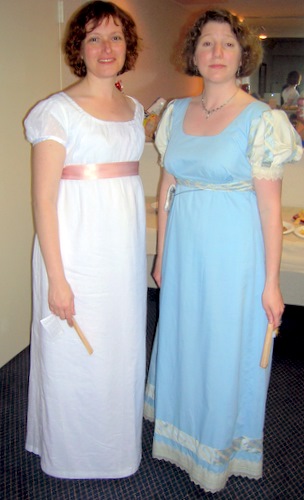
I arrived at her signing at a quarter past five o'clock. She stood on a raised stage with a hand fan, the epitome of a Grecian frieze in her blue Regency dress. (The fanboy author pauses to remark that he wishes he had pearly shoes like ones she wore.)

She spoke on a variety of subjects: women's clothing, male instructors of the womanly arts, the language of fans, dance etiquette, and the research efficacy of the only guide on Jane Austen and Charles Dickens I currently own. She entertained the audience by reading two passages from her novel, managing to speak convincingly as five or six distinct characters. (Here is an excerpt from the Shades of Milk and Honey audio book, read by Mary Robinette.)

She performed a brief Regency era shadow puppet show, after which she explained the history and workings of the set and props. I was particularly struck with how she held one puppet's controls -- possibly bamboo skewers -- and manipulated them like chop-sticks to make the puppet raise and lower his pickax while he stood and crouched (and I cursed my European stubbornness surrounding learning the art of eating with them).

Best of all, she revealed a love of a certain building material which I have utilized myself many times: cereal boxes from a particular local grocer.

After the book signing, she gave a talk to the assembled Wordos, which addressed the parallels between puppetry and writing. I was in awe as she illustrated her points by using the shoe (a sensible, modern one this time) off of her left foot as a puppet and effectively conveyed its emotions through focus, breath and motion. Of the many useful and practical comments she made, the one that stuck with me the most was this: The first-person narrative (while currently not fashionable in speculative fiction) works well when the narrator changes as a result of telling the story.

Her other useful comment concerned blogs, titles, and links: don't make them too cute (yours truly stirs uneasily, as being too cute is one of his character flaws); if you make them descriptive, they will make search engines work for you.

And then the delightful evening drew to a close. Thankfully, I have my signed copy of Shades of Milk and Honey, and if I exercise my memory, I can make the characters' voices approximate Mary Robinette's as I read.

Monday, July 12, 2010

I'm On The Top of the World...

My version of "The View from the Top" is available on the Analog website!

http://www.analogsf.com/201009/vft-johnburridge.shtml


It was written as part of a Wordos exercise. As an experiment to see what happens to the art and craft of story telling, several of us wrote a near science fiction story using an identical plot. Jerry Oltion's version of the story made it into print, but Stanley Schmidt, the editor of Analog, kindly put my and Joshua Skurtu's stories in.

Josh's story is here:

Jerry wrote a short intro (with spoilers) for the on-line versions of the story here. His story will be published in the September 2010 print edition of Analog.

I'm so excited to have one of my stories up on the Analog web site that I can't type straight; so I'll stop now.