Friday, September 10, 2010

Pausing Before Shrewsbury

"Now is the month of Maying / When merry lads are playing / fa la la la la / Each with his bonnie lass / upon the greeny grass / fa la -- "


Hey! Where did all these pirates, Elves, and chicks in chain-mail come from ?

Thursday, September 09, 2010

Why I Like The Pleiades

Why I like the Pleiades
  • They're really blue. They're the sort of blue I would like to wear. They're the sort of blue that belongs in diadems. They're the sort of blue that I would put into starship controls to let everyone know that the machinery is running optimally, making the starship skate along the stars like an Olympian Champion over the ice while Clara Rockmore plays Saint-Saëns' "The Swan".

  • They look like a tiny Big Dipper. This tiny Big Dipper is in the back of Taurus, the Bull, and it used to be an archery test to see how many of the little stars one could make out (and therefore, presumably how well you could see a target).

  • Their Japanese name is "Subaru" or "The Daughters of Industry," and you can see them on the hood of every Subaru car. Seeing them in the sky usually makes me say "Subaru" just because it's such a fun word and I wonder what the proper pronunciation should be.

  • But I think the reason I like them the most is that they (along with Orion) used to let me know if I had stayed up way too late as I was walking home from campus back in the 1980's. Sort of like a mother or a cadre of older sisters. Their reproach was silent. You'd look up, and there they'd be, silently to the left of the front porch if it was still before midnight, and just as silently to the right of the porch if it was after -- and you knew that the farther to the right (west) they were, the harder the next day was going to be. They were beautiful to look at.

Wednesday, September 08, 2010

Why I Like Antares

Why I like Antares.
  1. It's big and red, like the planet Mars; that's why it's called "The Rival (Anti) of Mars (Ares)." The star is an astronomy, a language and a mythology lesson all rolled up into one bright red package.


  2. It's the heart of Scorpio, the Scorpion. Scorpio is one of the few constellations that actually looks like what it is (in this case a really big scorpion). And it's wicked cool if only for the reason that if I'm going to have to be looking at a scorpion, at least this one is made up of twinkly stars, is light-years away and is unable to sting me.


  3. And finally, and best of all, every time I see Antares, it's an excuse to channel my Inner Nichelle Nichols in her role as Lt. Uhura and start singing "Beyond Antares."

Tuesday, September 07, 2010

Jupiter and Europa

The other night, I had a chance to watch Europa come out from behind Jupiter. (Kids, don't try this at home unless you want to lose your night vision.)

We'd been out in the country, away from the city lights, for about three hours. I'd say it was 11 PM. The Milky Way appeared in a blaze of glory from Sagittarius through the Summer Triangle, to Cassiopeia and Perseus. I stepped up to the telescope's eyepiece, mindful of the piercing cone of light which would resolve as (very) bright vision of Jupiter. I eased my sight onto the focused light, aware of my spasming right eye and contact lens.

Jupiter was as big as a button compared to the pinpricks of the stars. It was milky with bands of pastel red and orange. Three of the moons, Calisto, Ganymede, and Io, shone brightly in a line about ten o'clock to Jupiter. On the planet's opposite side, appearing as a goose pimple on one of the gas giant's darker bands, I could just discern Europa.

"Call the Pope," I joked, as Europa pulled away from Jupiter, and rose like a new bright star. Jerry Oltion pointed out that the telescope we were using has a much better resolution and magnifying power than Galileo's. But still, as I write this, I can't help but
  1. think about how I know that I'm looking at smaller bodies orbiting a larger one and so it's easier for me to attribute Jupiter and Europa's light show to Kepler's Laws of Planetary Mostion
  2. wonder how many modern people like myself have witnessed a moon coming out from behind a planet through a real live optical telescope.


I think I'll stop here before this turns into an intersection of science and religion essay.

Monday, September 06, 2010

Astronomy with Jerry Oltion

Last night Jerry Oltion and I went traveled a little East and South to the hills above Eugene for a little star party.

I was kicking myself for not packing a camera so I could take photographs of Jerry's telescope, which is a large reflector (I want to say he has an eighteen inch primary reflector) with a focal length of about eight feet. I'm trying to remember if Jerry's built this one from scratch, or merely (?) ground the mirror. He's able to fold it up so that it fits in his VW bug. There is no tube; the eyepiece and side reflector are held in place with by a kind of scaffolding of metal struts. Jerry has machined the struts so precisely that he doesn't have to worry (too much) about the optics not working after telescope assembly.

Jerry knows the sky very well, so he swiveled the telescope around to stars like Antares, a host of globular and open clusters, and various nebulas. I think one of the coolest sights through the telescope was a ruby red carbon star. It's a star that has accumulated a carbon ash atmosphere, which the sun heats up so that it is glowing like BBQ coals.

We also spent the evening looking for Sol-like stars within twenty light-years of Earth. This meant we spent an awkward moment or two realizing that we could remember back to 1990 and what we were doing then and what we would have done differently. Luckily there were no twenty-year-olds there to chime in, "I was a baby back then."

The most dynamic viewing was of the International Space Station. With Jerry helping out -- OK, really doing most of the work -- I was able to track the ISS in his telescope as it appeared in the west and arced north through the sky. Doing so was counter-intuitive as the image is reversed, so I had to push the telescope up when it appeared the ISS was falling down out of the field of vision.

When the ISS first appeared, I saw the sun reflecting off of its solar panel array. This appeared as a bright, yellow-white square. As we tracked the ISS, the solar panels were tracking the sun, so they appeared to change from a white square to a reddish diamond. Jerry's telescope was able to follow the ISS after it had dimmed beyond human eyesight.

And, of course, I got home very late.

Friday, September 03, 2010

NYC Greyhound Photo

Yesterday I was helping my Mother clean off her old computer. It reminded me that I have a lot of old photographs on various machines and, like many middle-Americans with digital cameras, I have a ton of photographs I should print out into an album (and, Mark would add, "Cull mercilessly."). As I was reviewing my photos, I ran across this one.

I like this photograph because A) it's a cool greyhound and griffin hybrid, B) it's in New York City near the Metropolitan Museum of Art, and C) it's near a Maison du Chocolat. Seeing it also reminds me of our New York friend, Lime Green Larry, mostly because I seem to always call or text Larry when pass this particular gargoyle.

Strangely, although visits with Larry are often a feature of our New York City adventures, I think we've only visited with him in the MET once. And it occurs to me that I've been a neglectful friend, for though I'm sure that Larry knows how much I love the Egyptian and Near East wings, I only think Larry likes the Roman Marbles. And it's possible that he prefers the MOMA to the MET (I do know how much Larry loves Balducci's and Maison du Chocolate, so there's some hope.).

Time to reach for the phone....

Monday, August 30, 2010

Dog Tag Machine Photos

During our travels, we chanced upon the Coast Guard Barracks Museum. In their front office was an old US Military dog tag maker.


They said that the machine had been found in a warehouse and they plugged it in. The keyboard mechanism reminded me of old typewriters my Mother's Mother had, and the keyboard typeface reminded me of my Dad's old typewriter.


The machine was turned off and sat quietly behind the front desk. For a small fee, the docents would create dog tags for you right then and there.

The staff were very nice about me sticking my camera practically into the guts of the machine.


I was fascinated, and I almost had dog tags made just so I could watch the machine work. I imagine electromagnets deep in the machine would throb the keyboard and perfume the room with ozone and machine oil. I imagine the ratcheting sound and the dull thuds of typeface slamming into aluminum blanks.

But Mark assured me that he didn't want dog tags, and I figured they'd only wind up lost somewhere, so with a slight pang of regret, we left the museum without any.

08-30-2010 Early Morning Dream

Drempt I was Cleopatria (I was in Liz Taylor's body). The Romans were invading Egypt, and Egypt was repelling them using a device from a story I've yet to sell. The dream started before actual fighting. For some reason, the Romans were building a dike out of very large rectangular stone slabs - the dream wasn't very clear on where, so I'm not sure if it was in the Nile or in the bay of Alexandria. They gave a flimsy excuse about building the dike, but everyone knew it would be a staging area for their navy.

So Egypt built one, too, only more with more decorative stone slabs. As the construction of the dikes continued, neither side believed that they weren't going to be used for a big battle.

There was a scene change, and I switched to omniscient viewer. I'm not entirely sure who they were at first, but they turned into Cleopatria and Antony (although I have a vague notion the man was based on Rex Harrison). The woman runs into a twenty foot by twenty foot library / conservatory. One of the stone walls has a window in it leading to a kind of niche or interior room with tomes on the shelves (I am having problems describing the wall's window because of dream-logic architecture). The woman giggles and hides beneath the window (she must have crawled through it).

The man enters the room. He's pretty sure she's in the room as there's no other door. He traces the perimeter of the room, one eye on the door, one eye looking at the shelves and the art on the walls. As he passes the window (which looks like a kind of painting), cartoonish, stylized wiggles appear in the air (it's as if the dream wanted to turn into a cartoon, and the wiggles show the viewer there's a smell coming from the window). He keeps sliding along the wall, but now the scent of her perfume diminishes, and he slides back to the window, certain he can sniff her out.

Of course he finds her and a (ahem) romantic scene follows.

Insert naval battle here.

Hanging over all of the dream was the knowledge that asps in a tomb were the final outcome.


Then I started some other dream with a science fiction space opera theme.

Let's see...
  • imperious, omnipotent, the-penalty-is-a-horrifically-painful-death, disembodied-booming-voice alien bent on carving up the Earth. Check. (In waking life, think The Borg meets Ming the Merciless.)
  • Final band of multi-cultural human freedom fighters holed up in a kind of Mayan Temple (with a stone arch the underside of which is painted as a rainbow). Check.
  • Last chance, super-techy, super fast, super small, spaceship in the shape of a silver sphere. Check.
  • Crazy, suicidal plan to delay omnipotent aliens with a, "you can't find us and our secret on the Moon" red herring (complete with high-power energy beams and plumes of lava from the moon raining down onto the Pacific). Check.


The battle scenes did have an annoying feature in that the two spaceships involved repeated targets and intentions to themselves (almost like part of me was narrating the story and another part was rendering the story in images, but needed to be reminded).

Sunday, August 29, 2010

Cape Blanco 1905 Wedding Dress

Across the bay from Cape Blanco Lighthouse is the Coast Guard Barracks Museum. It's kind of small, with a curious collection of items ranging from 1900 to the 1960's.

When I first saw the dress on display I was reminded of my Mother's Mother. She grew up in Astoria, where the Columbia River spills into the Pacific, and she was born in 1909.

Apparently, the person for whom this dress was made had an 18 inch waist. I'm going to guess that the person who made the accompanying placard does not.


I'm not entirely sure why this wedding gown is in the collection, and can only conclude that this is what a Coast Guard wife would have been married in in 1905. What prompted me to photograph it were the rows and rows of buttons, the embroidery/tatting and the simplicity of the cut of the jacket and dress.

The lighting conditions were not optimal for photography and I ended up with a reflection of myself in the photo.

Saturday, August 28, 2010

The Downside of Electronic Submissions

I was speaking with some writer friends the other day about various professional markets which accept electronic submissions.

"Oh, it's wonderful," I said, "I love being able to send electronic manuscripts."

"Yeah," said somebody, "but the flip side is that I've heard people say, 'I was pretty sure that my story was bad, but I sent it anyway.' I mean, that's taking Don't Edit for the Editor a little too far." There followed tales of obvious first-draft stories submitted simply because submission was the click of a few buttons instead of a $5.27 visit to the post office. Then the conversation concluded with conjectures on which editor would be the last one to adopt on-line submissions.

At first I was going to comment here that sending sub-par manuscripts is simply disrespectful, not only to a magazine's editorial staff, but to yourself and your corpus of work.

Then I was going to say it seems like a good way to get slush readers to groan when they see your name at the top of a manuscript.

But the end result of writers too lazy to do another pass on manuscripts before hitting the Send Button-- the one that affects me and every other serious writer -- is that now when I get a rejection, I'm much more likely to get a form rejection.

Gee, thanks. Not that I expect editorial staff to critique, but it will make those very rare instances when they do take a moment to add additional comments all that more meaningful.

Friday, August 27, 2010

Meditations on Little Girl Protagonists

Blame it on Lucy Pevensie, Jill Pole, Polly Plummer, Sarah Williams and Lyra Belacqua, but once again I find myself resisting the urge to write an urban fantasy with Yet Another Girl-Child Heroine.

"Jill" is one of my default Jane Doe characters. When I'm jotting down a quick story idea, the first female name that pops into my head is usually Jill. Men are usually twenty-somethings named Fred.

[Oh Hell! I just realized I'm perilously close to re-writing Labyrinth (makes note to self on where not to take the story). And over the course of writing this entry, fifty year old infrastructure for downtown Eugene has caused an explosion and electrical fire in an underground vault in downtown Eugene. It's looking more and more likely that a large explosion is in my story's future.]

Back to child protagonists: A long time ago, a friend of a friend's child was the proto-typical bad little girl. We used to joke that she was a 35-year old divorcée trapped in an 8 year old's body. Her mother would dress her up as an angel for Halloween, and as soon as you could say Trick-or-Treat she'd ditched the halo and dressed up as a hooker. The next Halloween, she appeared as (I am not making this up) a vampire sex-goddess. Ironically, her mother was the head of the local chapter of Planned Parenthood.

The best thing about the proto-bad-girl was imagining what she would do as an adult: it involved seducing her good-girl friend to go riding off in a black halter-top on the back of a motorcycle with a leather vested, ponytailed, motorcycled dude named Snake for the benefit of giving the good girl's father an apoplexy.

And that underlies the dangers of girl-child protagonists.
  • They lend themselves to symbolism, and so we have the pure, faith-driven cypher, Lucy Pevensie, who triumphs over adversity solely by pluck.
  • They become meditations on innocence, adulthood, and the loss of innocence, and so we have characters like Sarah Williams and Lyra Belacqua.
  • Or, in my case, they become asexual, very clever adults trapped in a ten-year-old body. . . which, as I think about it, means I'm trying to re-write Anne Rice's vampire-child, Claudia.
But the main reason that I shy away from child protagonists is because children in our society have little to no power, which makes it hard for them to be protagonists in a short story. Especially an urban fantasy short story.

World's Largest Bromley Dance

Oh man!

Someone just sent me this link to the California Revels Bromliad : http://californiarevels.org/bromliad

And now I wish I could and be one of the hundreds of people all dancing the Abbots Bromley Horn Dance All At The Same Time. Alas, previous engagements and responsibilities will keep me here. Not to mention little inconveniences like figuring out (and paying for) transport and lodgings.

The Abbots Bromley Horn Dance is one of the few English folk customs to survive both the Reformation and Cromwell. It's a folk processional performed on Wakes Monday and it involves six dancers clacking reindeer horns together. To a kind of spooky tune.

Oh well. I guess I'll have to be content dancing it in a few weeks at the Shrewsbury Renaissance Faire.

Wednesday, August 25, 2010

Mary Robinette Kowal's Visit to Eugene

At the risk of gushing like a simpering fan-boy, I must set down my impressions of when Mary Robinette Kowal was in Eugene, this Tuesday last, as part of her signing tour for her novel, Shades of Milk and Honey. Mary Robinette is a professional puppeteer, author, and voice actress. She is also the current vice-president of SFWA.

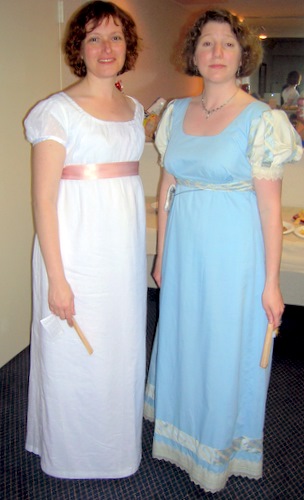
I arrived at her signing at a quarter past five o'clock. She stood on a raised stage with a hand fan, the epitome of a Grecian frieze in her blue Regency dress. (The fanboy author pauses to remark that he wishes he had pearly shoes like ones she wore.)

She spoke on a variety of subjects: women's clothing, male instructors of the womanly arts, the language of fans, dance etiquette, and the research efficacy of the only guide on Jane Austen and Charles Dickens I currently own. She entertained the audience by reading two passages from her novel, managing to speak convincingly as five or six distinct characters. (Here is an excerpt from the Shades of Milk and Honey audio book, read by Mary Robinette.)

She performed a brief Regency era shadow puppet show, after which she explained the history and workings of the set and props. I was particularly struck with how she held one puppet's controls -- possibly bamboo skewers -- and manipulated them like chop-sticks to make the puppet raise and lower his pickax while he stood and crouched (and I cursed my European stubbornness surrounding learning the art of eating with them).

Best of all, she revealed a love of a certain building material which I have utilized myself many times: cereal boxes from a particular local grocer.

After the book signing, she gave a talk to the assembled Wordos, which addressed the parallels between puppetry and writing. I was in awe as she illustrated her points by using the shoe (a sensible, modern one this time) off of her left foot as a puppet and effectively conveyed its emotions through focus, breath and motion. Of the many useful and practical comments she made, the one that stuck with me the most was this: The first-person narrative (while currently not fashionable in speculative fiction) works well when the narrator changes as a result of telling the story.

Her other useful comment concerned blogs, titles, and links: don't make them too cute (yours truly stirs uneasily, as being too cute is one of his character flaws); if you make them descriptive, they will make search engines work for you.

And then the delightful evening drew to a close. Thankfully, I have my signed copy of Shades of Milk and Honey, and if I exercise my memory, I can make the characters' voices approximate Mary Robinette's as I read.

Cape Blanco Photos

The other week we went to Cape Blanco. The Cape Blanco lighthouse is one of the highest lighthouses on the west coast.

In this photo, the sky is clear, but the previous afternoon, the heat in-land, 95F, drew the moist sea air inland and created a bank of fog so think the lighthouse was not visible from the visitors' parking lot.


The steps were very steep.

And modular.

We were asked not to touch the bricks as we climbed.

I kept waiting for the cast of Disney's 20,000 Leagues Under the Sea to pop out somewhere, pose dramatically, and start singing.


I took many pictures of the lens and light assembly. I like this one because it reminds me of an old drawing of the solar system or an atomic structure. Or magnetic field lines.

The original light would have been a flame fueled by (if I remember correctly) clarified lard. Turning the light off involved letting everything cool down slowly to prevent breaks. If the air temperature got too cold, the fuel would begin to solidify (I think it became jelly-like).