Sunday, March 25, 2012

Sea Lion Caves 2012-03-25

Today we ended up at the Sea Lion Caves.


They're on the Oregon coast, underneath about 180 feet of basalt cliff.  If I'm remembering the signs correctly, the sea lions we saw were mostly cows and calves.  The bulls hadn't come back yet, or were too busy somewhere else figuring out how to get a herd of cows for later in the spring.


These sea lions were mostly keeping out of the rain and the storm (and earlier in the week the snow) that was outside the cave.


I'm trying to remember when I was in the caves last.  I have a hazy memory of walking down a set of stairs that leads to a viewpoint now.  In any case, what these pictures don't convey is the smell, which was salty, sea lion poopy, and dead-fishy.  It sounds worse than it actually was; we got used to it quickly and it really wasn't all that bad (although I wouldn't want to eat a snack there).  The pictures also don't give a sense of the noise: the barking, the wailing, and occasional squeaking; and over everything the splashing of the breakers against the cave rocks.

The cave has been a sea lion hang-out for a very long time; a Captain Cox found this skeleton around 1880 (the head was stolen in the 1950's).

We stayed for a while, then went back up to the visitors' center to look at touristy gifts.  The whole set of photos is HERE

Saturday, March 24, 2012

Notes: Ursula K LeGuin

Talk at the Eugene Library.
(any misquotes, typos or mistakes are my own)

Le Guin:  [I want to focus on the question]  What happens when the the people in charge say hide or burn the books?

Reads excerpts from "The Telling."

All fictions writers dread the question, "Where do you get your ideas from?  The answer is, "Out of my crazy head.   But now and then you know where the crazy ideas get into your head.  I got the ideas for "The Telling" from China and Chairman Mao and the suppression of Dauoism.  The process was ruthless and methodical and went on for 40 yeas.  Around 1982, they opened up the temples as tourist attractions.  A religious practiced for 2000 years was erased in my lifetime.   But and I didn't know about it at the time.

Ignorance is what allows such things to happen and keep happening.  Ignorance is what despots and ideologues want.  Ignorance will allow or applaud violence against what it doesn't understand, which is by definition everything and anything.   I was ashamed by my ignorance, by writing a novel maybe I was trying to atone.  I don't know.  In the book I wanted to show a theocratic state and a secular state [both suppressing free thought],   To me theism and atheism are equally dangerous.

[...]

I also want to say the more we fudge on the separation of church and state, the more we check our powers to check bigotry and demogrogary.  To say that we are a Christian Nation is an ignorant statement if not an outright lie.   America is a secualr democacy in which Christianity is one of the largest religions out of many which the government supports equally.  We've been drifting away from that neutrality.  We should activelly trust toloerance to keep from losing our freedom.

(Self observation/question what is it about Library of Alexandria, Library of Trantor, Asimov's Nightfall, Feihrenheit 451, and The Telling  that compels certain readers -- is it a form of bibliophilia, a Reader's version of The Fall, or something else?)


MODERATOR:
You started writing at SF at  age 11.  What drew you to the genre?

Le Guin:  I just have a weird mind.  At 9, 10 and 11, my brother and I were reading Astounding SF and Amazing Stories.  So , I liked these short stories, and I thought, maybe I could write one of these.  So I submitted.  And I got a rejection slip that lasted me 20 yaers.

MODERATOR:  What challenges did you face publishing?

Le Guin:  When I got into my 20 I was seriously writing for 6 or 7 years without acceptances.  Finally, within the same week I sold to a SF and a literary magazine.  The SF magazine paid and the literary one didn't... so I had a certain bias for that.

MODERATOR:  [Lists various awards]  What do you think about literary awards?

Le Guin:  Its a big and complicated topic.  I think the trouble with literary awards. They are wonderful for young and first writers.  My first awards gave me a confidence that  I really did have readers out there.  The nebula and hugos are voted by writers and readers, not judges.  I think a problem with a lot of the Big Literary wards is that they are  selected by a panel of those judges.  In the US, the judges are predominately from the Eastern half of the US and they don't care so much about what happens in the West.  Too few awards are are Really BIg.  The Newbury Award is the only really big award for children's lit; but there are no other children's awards.  There aren't runner-up for Newbury .   We put ay too much weight on our book awards.

MODERATOR:  What experiences have you had with censorship?

Le Guin:  I havnt had many experiences that effected me directly.  What hit fantasy very hard started back in the 70s was fundamentalis Xtain decsion that Fantasy was Evil (witches).  So a lot of school baords got members etermined to get SF/F away from the kids.  Its censorship through the schools, which is dangerous.  And here I did run into it directily a couel of times.  I went to a hearing on my Books, because the studens to fhte High chlass stood up and defened The Lathe of Heaven (Iwant to decide that LoH is really stupid myself).

MODERATOR:  Films?

Le Guin:  The LoH in 1980 which is perfectly available still... I was in on the scripting and everything that I could b on.  I think we did a pretty good job.  Good acting... the script is so  so.. After that it was down hill all the way.    ... Its hard I didnt have to .. (makes face)

MODERATOR:  What do you think about listening to audio-books?

Le Guin: Hearing books read aloud is different agreement [than reading them].  I think audio-books are great if you can't read; [and I think we all love to be read too I like to be read to].

MODERATOR:  What are your observations about E-books, publishing, and print?

Le Guin:  Can we stay here for a week?   Ebooks are another way of doing books.  Now we have two big ways of doing books.  They each have their virtues and I hope we keep them BOTH (because they complement each other).  Yay for Libraries which have to keep up with the technology.  It s a difficult job for them to do.

MODERATOR:  You moved from Berkeley to Portland.  When did you move, what's the thing you like best about Oregon?

Le Guin:  The rain.  :-)  1959.  I have a list of things I like; Oregon is a great place to live.

[The moderator opens up the microphone to the audience]

AUD:  What would you say to a younger writer to encourage them?

Le Guin:  Its kind of rough to to encourage them.  The print publishers are thrashing.  The ebook world is in flux.  Therefore, a lot of bad things have happened.  A lot o the commercial publishers are demanding security.  Things are _harder_ now.  I can say, "just say hang in there, it will be wort it."

AUD:  How do you write; are you an actor in the story or a watcher of the story?

Le Guin:  I'm a listenier, especially if it the story has one person's point-of-view.  My novels come with a voice... :-) I hear voices in my head.

AUD:  I've been reading you for years... what are the books you go back to over and over and over again?

Le Guin:  I have read voraciously and constantly ever since I was five... many, many books.   ... Dickens, Woolf, Patrick O'Brian.  there are so many good writers.

AUD:  "Love does not just sit there like a stone, it has to be made like bread... " (quote from "The Lathe of Heaven")  How does that thought inform your thinking?

Le Guin:  The reason for that sentence in LOH:  "I'm not going to tell you how they make love"  If you want to read about lovemaking, there's a lot of that.  I think the actual act at the moment isn't interesting:  ITS DIFFERENT EVERY TIME.

AUD:  What ideas do you walk away from, OR what do you step away from?  How do you cut things?

Le Guin:  The filter is just there.  I never think of writing something I don't want to write.  My filter must be through temperament or experience built in. [Sorry, that probably doesn't help you too much.]

AUD:  What's your favorite thing you've written?

Le Guin:  The one I'm thinking about at the moment.

AUD:  Did you have a cat in the past who inspired Catwings.

Le Guin:  No, we've had and have cats.  But the idea came from doodling on a fridge list.  I drew a cat flying and looking smug.   And I looked at the drawing and asked, "What if you had a family of cats with wings?" [...] It was like the cat flew into my head.

AUD:  Some say there should be no copyright; some say copyright should be indefinite.  What's your stance?

Le Guin:  Most authors have a stance.  It think both positions are incredibly wrong and wrong-headed and unthought-out.  I am in favor of copyright because it is how authors make money.  If you don't own the rights to your work so you can sell it, how are you going to live?  [Without copyright] You have to find a patron; that is what they did up to the 18th C.  Copyright saved authors and gave us 150 years of the ability to make a living.  What went wrong was the Disney Law.  Copyright should be the author's lifetime + 25 years for their heirs.  DISNEY keeps extending copyright, which will destroy it.  Copyright encourages pirating.

AUD:  As a writer, is there a criteria that you hold yourself to when writing?  Do you apply those criterion to others' works of art?

Le Guin:  No... the criterion is too complicated.  To set up any list of criterion of excellence immediately becomes a straight-jacket.  You have to wing it.  You have to [be able to look at what you're working on and say "This needs more work" or  "Yeah, I think I got it."

AUD:  IS Science Fiction in a negative rut?  Is every future is a distopia?  Is the World is doomed?  Is this a sympom of the times?  Can SF writers do anyting about it?  Is it possible for SF to make a difference?

Le Guin:  Its a pendulum swing.   In the 30s we would have stories about a bright, democratic galaxy.  [...]  my trouble with [science fiction] right now is that it's unpleasant, it's highly intellectual and has no emotional vitality.  It's a sort of "Brainiac" mentality.  In order to speak to people on a deep level, it has to include more than just negative emotions.

AUD:  (Tesseract faux-pas).  How do you see SF/F as being an integral part of education?

Le Guin:  But I don't know ... if literature isn't a part of education....

AUD (a couple):  We live in a householf of writers and artists and you're our patron saint. (Presentation of Poems)    ... and thanks for helping me to become a whole human being.

Tiara Mania

Tiara Mania: Who knew?  Now I'll have to make sure to tell Alethea Kontis about it.

Wednesday, March 21, 2012

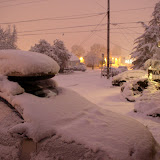
March 2012 Snow

It's the second day of spring.

It's snowing:

FirstSnowofSpring2012

I think this is the most "artsy" photo I took.  And I'm being called back outside...

Monday, March 19, 2012

Hieroglyphic Name...

I'm having way too much fun at

http://hieroglyphs.net/0301/cgi/pager.pl?p=42

generating my name.


This reads, "King of Upper and Lower Egypt, the Good God, John, given life, stability, and wealth, beloved of Hathor."

Saturday, March 10, 2012

Printing the Scarab

When I'm not writing, I play with Blender. Blender is a 3-D rendering program, sort of like AutoCad. It has a programming language, Python, that it can use to make mathematically precise models (and, goodness knows, you have to be precise when you're making 3D virtual star tiaras).

Over the winter, I've focused on geometric designs, but the latest project has been a scarab.


It turns out that Blender objects are pretty easy to export to files that MakerBot can use. So when Mark Wild said that he was going to visit the Eugene Maker Space and play with their 3D printer, I tagged along.


The setup took a little longer than we expected. But once everything started up, we were able to load a STL file of the scarab onto the MakerBot's rendering engine. Our first big surprise was how small the scarab was; we had to increase its size by four times.

Our next snag was discovering that the MakerBot G-code build (the set of instructions that actually make the MakerBot printer extrude plastic) wanted to save to my RAMstick, which I'd write-protected.  Once we figured that out, the software took about five minutes to figure out the best path for the plastic printer head to take to create the scarab.   And then another ten minutes to print it out.


The end result didn't come out as solidly as I thought it would, although it is recognizable as a scarab.


What I learned:


  • The scarab design was too detailed and small. The parts that came out the best were the circular solar disk element and the dung beetle's carapace. What seemed like huge chunky bits to me when I was creating the scarab model turned out to be itty-bitty when printed. We probably would have had a cleaner print job if we'd expanded the model one more time.
  • I should have put down a base to build upon. To make the wings' feathers stick out, I put all of them on the zero Z plane and then varied their thickness so the leading feathers were thicker than the trailing feathers. The feathers probably confused the MakerBot G-code because there were about fifteen, they overlapped, and by design they weren't all able to touch the printer's bed.
  • I think next time rather than build a complex objects out of multiple overlapping ones, I'll see how much leverage I can get with a simpler design and one object with multiple Boolean difference "cuts" out of it. I also suspect that the procedure I followed to clean up the model didn't catch interior planes and vertices, which resulted in some, um, non-intuitive printer head paths. Or...um... use Boolean difference on the overlapping feathers.
  • The MakerBot print head will approximate its print path in an attempt to fill an odd shape with plastic. It's not so much a limit on the printer head so much as it's a limitation of the melted plastic coming out of it. Which means you may or may not get the coverage you thought you might. An analogy would be trying to use a tube of toothpaste mounted on an etch-e-sketch to sign a check.


But, even though it looked a little like something Spiderman might make out of his webbing, I love it and have something to put on my forehead when I say, "Almighty Isis (Isis-Isis-Isis)!"


Wednesday, March 07, 2012

Higgs Bosons?

I wish I knew a little more about this to be able to write a short story about the Higgs boson.  I can imagine writing something whimsical, like a boson leaving behind a trail that says, "Hello!" I have a more difficult time imagining writing something hard science fiction, like a submarine powered by a Higgs boson.

Higgs Boson May Be Indicated in New Data - NYTimes.com: Physicists from the Fermi National Accelerator Laboratory in Batavia, Ill., say they have found a bump in their data that might be the long-sought Higgs boson, a hypothesized particle that is responsible for endowing other elementary particles with mass.

Although, looking at a picture of the Tevatron, maybe Higgs bosons could be used to propel a space station... or maybe there's something about the Earth's mass that requires Higgs bosons to be more easily formed outside Earth's gravity well.

Monday, March 05, 2012

It's Worse Than That...

It's art.

Last October we visited the Portland Art Museum, and we were encouraged to dress like the art.

Sunday, March 04, 2012

Saturday, March 03, 2012

Critiquing Memoir

Every now and then someone submits a memoir to the Wordos.  This is usually confusing to the table because A) memoir is typically an idea plot hidden underneath a event plot, and B) it can be difficult to look at just the text of a memoir and critique protagonist in the memoir as a well-written character and not the author as a person.


One of the things that I learned from a memoir writing class was that a good memoir has a rhythm or procession of symbols that can be discovered within individual vignettes, and this rhythm is mirrored in the overall memoir.  In general, the vignette follows the form stasis, discovery, tension, more tension, crisis, conclusion.  This was extremely helpful to realize when I went to see the movie, "Before Night Falls," based on a posthumous memoir of Reinaldo Arenas.  The movie was much less confusing once I realized that every little story (and the entire piece) was using the metaphor of a rising above everything in a balloon which is out of control and subsequently crashes.

It was suggested by our instructor that the events, settings and people we write repeat -- sort of like the same way the same symbols would aggregate in a dream journal.  She further suggested that we write stories about ourselves to explore a question we are asking ourselves.   For example, in my class assignment, it was pointed out to me that I chose to retell events involving attempts at expansion by ignoring rules of physical safety (a canoe stunt, trancing out on the dance floor, a near-accident skydiving, and an automobile-bicycle collision).  My memoir was organized around self-identity and boundaries.

If you choose to cast a life event as a memoir, you might want to ask, "What does this event (or series of events) mean to me?"  Or you might look for emotional similarities.  Or you might ask, "What have I learned at the end of this that I didn't at the beginning?"   Also, truth is stranger than fiction.  It may be true that X happened in real life, but it still needs to be plausible in a manuscript -- so for the sake of readability, an author can and will take poetic liberties with events.

In terms of critiquing memoir -- or any manuscript for that matter -- it's also helpful to keep in mind the narrator of a manuscript is a character created by the author, and that an author is not one of their characters.  In memoir, it can be easy to lose track of the boundaries between the author as a person, the author's persona, and characters in the manuscript.  Address the text, not the author.


The American form for memoir was set by Frank Conroy in "Stop-Time." (It's not always cheery reading.)  An interesting look at author, persona and memoir may be found in Ruth Reichi's "Garlic and Sapphires."

Friday, March 02, 2012

March 2012

It's March.

I am coming out of hibernation mode.  A sense that there is something that I should be doing is building, and I expect that I should be back into the writing, editing, and submission routine soon.  Oh, and blogging.

One of the trends that happened over December, January and February is that I seem to be posting to Google Plus more than blogging here.  I'm hoping to discover a method that will let me post here and in Plus.

In the mean time, I've been playing with Blender and other graphic tools.  I don't know what it is about this time of year, but as I was saying to a Wordo the other day, this is when I want to think and write about religion, explore geometry, and draw pretty pictures -- so rather than fret and stress about the Verbhounds gnawing off my legs, I enjoyed the writing down time.

Wednesday, February 08, 2012

Notes on Critique

Notes on Critique.

Before I begin, I want to say that I've been critiquing at the Wordos table for ten years.  So, yeah; I've got experience, but what I'm going to say is just my opinion, and while my methods and observations work for me, you may have a different method or focus that works for you.

What I want to say tonight boils down to "Stay focused, be helpful, and play nice."

Stay focused on critiquing words.  Focus on the words, not a story's worth as "art."  Focus on the manuscript, not on the author.

Be helpful, and by helpful I mean use specific examples from the text when praising a manuscript or pointing out its flaws.  Also, don't repeat yourself too much.

Play nice, remember that we all have stories to tell, and the manuscript before you represents the best version of the story the author had at the time of submission.


The primary goal of critiquing stories is not to give a writer feedback, although that's a nice side-effect.  The primary goal of critique is to get folks thinking about writing and engaged with what works and what doesn't.  After critiquing a while, the patterns of good (and bad) stories become more visible in seed form, and that in turn helps with the writing process.

One of the dangers of a critique group like the Wordos is to come to the table thinking the critique process is going to provide a magic bullet that will fix your manuscripts' problems.  Sorry.  Nobody loves your manuscript more than you do, and it's your job as a writer to make it the best that you can.

I think another of the dangers of participating in The Wordos is that writers can lose track of their individual voice and begin to fall back on the Wordos Default Story -- which is sort of the Default Writers of the Future Story -- which is the five point stasis, try-fail cycle, crisis, conclusion story.  This danger is harder to address, and all I can do is remind folks that the table has and will savage Hugo and Nebula Award Winning Stories that were outside the Wordos Default Story.


So, when critiquing, here's what I do:

As I read the manuscript, I make notes and ask questions in the margins and mark up any mechanical problems.

When I find myself getting grumpy over a manuscript, I moan and groan and channel mean French language instructors from David Sedaris books.  And then I try to remind myself that the story on the page is the best story that the author knows how to tell.  I remind myself that editors like Ellen Datlow want storytellers to succeed and are silently cheering for their manuscripts.  The author has a story they're trying to share, and it's not my job as a critiquer to take out an editorial machine gun and fill the manuscript with holes.  Saying where I'm confused or the manuscript isn't working for me is valid, but so also is saying what works and doing a little bit of cheer-leading over the parts that work.

On the back of the last page, I write down my critique.  I do this because it helps me stay organized and allows me to mark points that have been said during others' oral critique so I can focus on what hasn't been said when it's my turn to speak.

I divide my last-page critique into several sections.  General remarks, Mechanics, Setting, Staging, Character, Plot, & Heart.

GENERAL REMARKS

In the opening general remarks of my critique, I try to say if I think the manuscript is ready to send to markets or if I think it needs more work.  I try to cheer-lead here if I can, and be honest about what is not working for me.

MECHANICS

In the Mechanics section I might say something like "Great language," or I might note where I had problems.  I might talk about the story's title or hook.  I might not go through the mechanical section during oral critique other than to say "I've marked some things down."

I think it's really easy when there's an experience imbalance to fall back on the nuts-and-bolts critique.  This is the sort of critique that goes something like, "Well, I mostly liked this," and then launches into a detailed review of commas.  It's safe and it answers the question, "Oh my god, how do I critique this without pissing the author off?"

SETTING

Setting and Staging are two different things.  In setting I gather together any notes on sensory details:  the smells, the sounds, and the sights.  A well-done setting will act as an additional character.

STAGING

In staging I'd note any problems with how the characters move or hold things.  Good description of character movement can be great alternative to having a character stand in front of a mirror or shop window.

I think it's easier to generate critique on mechanics, setting and staging.  But I also think that the critiques we give have to go farther, because a critique which is only addressing these things is only saying that a manuscript is clear and pretty.

CHARACTER

Characters should be interesting and it's helpful if they're sympathetic and complex.

Specific character points I'm looking for are, what does the main character want,  what actions they take to get what they want, and how are they changed by the end of the manuscript?

I think it's fine to say that one doesn't like a character, but I try to be very specific, saying that I lost sympathy for a character, or I no longer trust a character, or that I'm bored by the character because they're too stereotypical.  I cite page numbers.

PLOT

Prose should reveal character or move the plot forward.

When critiquing plot, one filter I've recently been taught is to try to figure out if the story is a milieu story, an idea story, a character story, or an event story.

A milieu story starts and ends when you enter and leave a location.  An idea story starts with a question and ends when you answer the question.  Character stories start when the main character is unhappy with themselves, and end when they either become satisfied or reconciled.  An event story starts when something upsets the status quo and ends when it is restored or everyone dies.

No matter what the story type, one way of thinking of plot is that it is a series of power reversals.  Another way of looking at plot is Action-Response-Reaction.  If there's no responses to changes in status, then the plot isn't working or has become a wish-fulfillment story.

As I said earlier, new folks tend to fall back on "safe" critiques and focus on manuscript mechanics: syntax, formatting, and grammar. These are fine things to focus on, especially if critiquing manuscripts is a new pastime or you don't want to offend an older author.  Folks with more experience will look at and focus on plot mechanics and plot logic holes. This works well for stories that follow the seven-point plot form, less so for stories breaking out of that mold.

This brings us to the story's heart.

HEART

A story works well when the reader discovers an Ah-ha! moment or when one of the characters (and by extension the reader) makes a discovery. A story's heart is bound up with the moral or message the story brings to a reader. Yes:  moral -- a tricky word to navigate.

A story's heart, as Jane Yolen puts it in "Touch Magic", is a truth the storyteller tells about themselves disguised as a story about the world which resonates with the reader.  For me, a story's heart shows how a particular character, and by extension the reader, find their place in the world through the choices they make.

If I can't find the story's meaning, I might try to identify a theme or themes.  I think critiquing heart can be tricky.  Sometimes I think a story's heart can get away from the author, which means as a critiquer I have to say something like, "There's a lot of themes in this manuscript, and the story might be better served by either increasing the word count or focusing on just one theme."  Usually when I critique heart, I try to summarize what I think the story's meaning is in about ten words -- and I have to remind myself that this can be devastating because sometimes what I think might be a light-hearted tone can be interpreted as mockery.


Once I've got my last-page critique written down, I'm set for the oral critique.  I listen to other oral critiques and write down dittos and dissents underneath my written critique.  I sometimes will say, "Ditto Nina" and then draw an arrow to one of my earlier written critique points.

SO...  It's our job as writers to provide the best manuscripts we can to the table, and as critiquers, we should treat manuscripts that way.  The best way to do that is to stay focused  about a manuscript's readability and saleability.    Be helpful by providing specific, concrete comments on a story's structure, and by playing nice.


Some closing comments, goals and challenges:

I'd like to challenge the table to eschew the word "you" in critique.  There used to be a ban on using "you" in critique, but we've relaxed that rule.  You in critique usually takes the form, "what you should have done," or "what you should do."  Using you tends to move the focus away from the manuscript and toward the author.


I think it's important to remember that while we are critiquing words on paper that there's a difference between critiquing craft and critiquing art.  It's somewhat helpful for an author to hear, "This didn't work for me" especially if it is followed up by specific examples.  It's less helpful to hear, variations of "I don't like this art or I don't like hard-military-bodice-rippers."  As an an analogy, I don't care for Mahler's (or is that Mauler's) music, so while I might say, "I thought the horns were too loud in the second movement," I wouldn't say, "this style of music is crap."

I do think it's OK to say, "I don't normally read hard-military-bodice-rippers, so my critique might not be that useful."  And I think it's less helpful to say, "Hard-military-bodice-rippers aren't my thing, so I stopped reading at page two."  Everyone has their own taboo subject; some people can't read gore, some can't read sex, and some can't read religious satire.  If a particular genre is repugnant to you and you really can't read it, just say "pass."


We have a "the author doesn't speak" rule.  But there's  an exception that people should know:  if the first critique completely derails the table.  For example, Gra Linnaea had a story on the table an the first critiquer spent their turn talking about how the story was about Ladybugs on Mars (disclaimer: made-up example).  It wasn't, but that didn't stop the second and third critiquers from beginning, "Oh, I thought this was about robots; but now that I see that this is about Ladybugs on Mars..."  To prevent a domino critique fail, it's polite to raise your hand and say, "Excuse me, but this is about robots, not Ladybugs."  and then let the critique continue.

[Mary pointed out that that one should try to remain true to one's original critique when confronted with a Ladybugs on Mars (mis-)interpretation of a story.]

So, remember: "When in doubt -- Stay focused, be helpful, and play nice."

Thursday, December 29, 2011

WiFi Users Should Use WPA2

US-CERT Vulnerability Note VU#723755 - WiFi Protected Setup PIN brute force vulnerability

Looks like The Bad Guys can break into your wireless network in just a few hours as opposed to a few days.   Time to make sure you're using WPA2.

Friday, December 23, 2011

A Lumbering Holiday Tale: The Video

The "classic" holiday tale returns in video.

Snake Dream

I was going on a hike with Mark in the fields and hills between my parents' house.  There was a group of us, but other than Mark, I don't recall who.  I quickly became separated from everyone, and was in a kind of cul-de-sac of blackberries in a field near Bald Hill.

I could hear everyone up on the hill, and I managed to find a trail leading through a lower place in the brambles.  The bramble paths pointed at an old brown cottage one way, and back the way I'd come the other.  I picked my way through the brambles and stepped over a small brook.

The hill and the fields transitioned at this point, I think.  They became less green and Oregonian and more arid, and more like the sonorian desert with cliffs.  I was too busy wondering about the lizard I saw scrabbling up and down a sandy dune.  I had the sense that this was a big lizard because I could see it well at a distance.

I wanted to catch up with everyone, so I headed toward Bald Hill, where I'd heard them last.  I became concerned about rattlesnakes, because I knew they'd like to sun themselves on the rocky slope.  There's a break in my recall, but the next thing I can clearly recall, I was being chased by a rattlesnake and another, smaller snake.  I was running and they were wriggling after me.

I say that it was a rattlesnake, except that this snake was banded black, yellow, and red.  Its rattle wasn't quite like a regular rattlesnakes, it was black and charred looking, like the remains of a log after a fire.

Despite running away, the snakes caught up to me, and then then rattlesnake proceeded to wrap itself around my neck and shoulders and sort of hang out.  I might have been bitten on the hand, but it was more like a grazing bite.

The setting transformed to a busy city street.  It was daylight.  I still had the rattlesnake wrapped around my throat.  I met a writer friend, but she was an amalgam of three different Wordos.

"John," she said, "I saw you from a distance and I said to myself, 'Is John wearing a rattlesnake around his neck?'  And you are!"

We had a small chat.  The rattlesnake might have changed color to something more like a rattlesnake's, and the rattle seemed less like a piece of burnt wood and more like the nestled buttons of a rattlesnake's tail.  I have a strong sense of the snake's coils.  Eventually the rattlesnake got bored or whatever, and shrugged itself off of me. 

I must have woken up or something because I was telling some folks about the dream and A.R. (also from the Wordos) looked at me like I'd just walked backwards on a high wire over a fire and said, "Well. You've certainly made your spiritual connections."


And then I woke up again.

I'm trying to figure out this dream, because I don't normally dream about snakes.  Usually after I cross a stream in my dreams, I encounter a stag or a panther or a raccoon or a white horse.  As a white person of English and Norwegian stock, I'm not grounded in Native American traditions, so I'm hesitant to break out the sage and say (in deep, serious, spiritual voice) Rattlesnake Is My Power Animal. 

But over the new moon and my birthday--both tomorrow--I think I'll be on the look-out for snakes and what they might be trying to tell me.